
On this page
Carpal Tunnel Release Surgery: Wound Care and Finger Movement
A short, evidence-based guide to the first days after carpal tunnel release—from the dressing, showering and warning signs to finger movement, returning to work and common questions.
19 min read
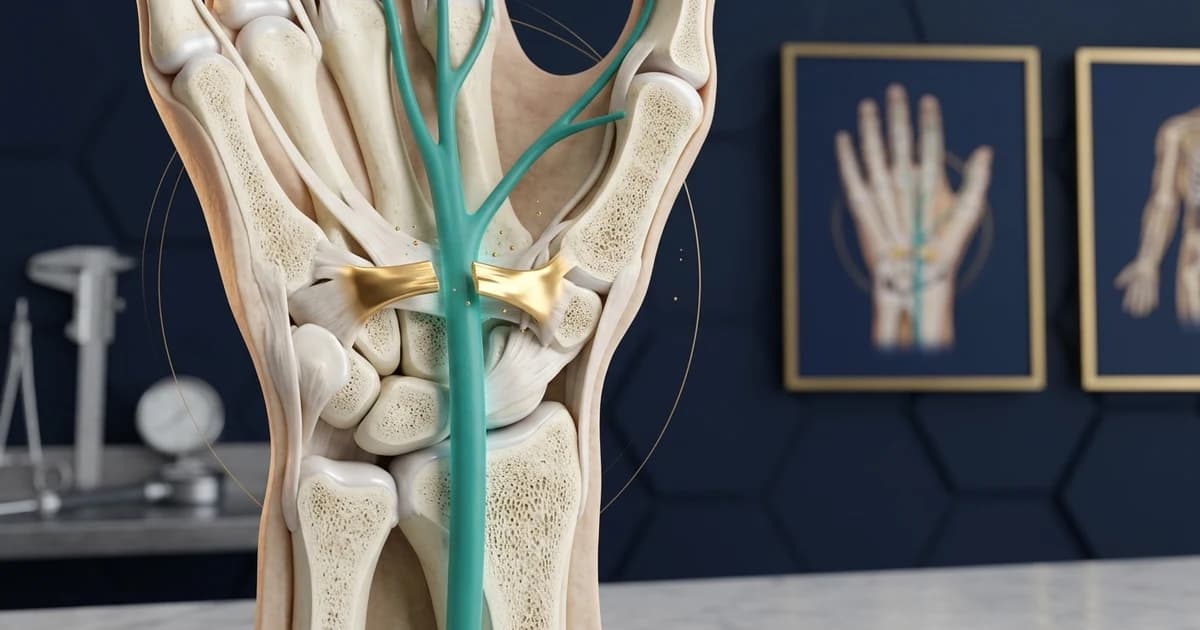
🏥 What happens on the day of surgery?
Carpal tunnel release is one of the shortest operations in orthopaedics. Most people walk home the same day and use the hand for light tasks that evening. What follows is the plan for your first days.
💉 Anaesthesia
The operation is usually done under local anaesthesia: you are awake, you can hear the conversation, and only the palm and wrist are numb. With the wide-awake, no-tourniquet technique, whose success rate in trials was not lower than a regional block, the hand stays warm and perfused throughout and the numbness wears off sooner.
🏠 How long you stay, and going home
- This is day-case surgery. You are discharged after a short period of observation once you are settled.
- Do not drive yourself. Someone should take you home, because the operated hand is bandaged and not yet fully yours to use.
- You go home with a bulky dressing over the palm. Collect your prescription, your written care instructions and your follow-up appointment, and keep them together.
🤲 What is expected, and what is not
- Expected: as the numbness fades, the palm feels more sore and burning. Mild finger swelling, morning stiffness and a tender incision line are normal in the first days.
- Expected: a small blood-tinged stain on the dressing that gets lighter each day.
- Not expected: pain the prescribed medicine does not touch, fingers turning cold or blue, new numbness you did not have before surgery, or swelling that increases day after day instead of settling.
⚠️ Warning signs: when to call immediately
Most people experience none of these. Read them once so you know where the line between "usual" and "I should call" sits.
🩹 Local wound signs
- Redness or warmth that spreads further from the incision each day.
- Thick, purulent or foul-smelling discharge, or a dressing that keeps soaking through with fresh fluid.
- The wound edges separating, or stitches coming away early.
- Pain that becomes stronger and throbbing after the first days instead of easing.
📞 Call the team the same day
- Fever, chills or feeling generally unwell.
- New numbness, tingling or weakness in the fingers that you did not have before surgery.
- Being unable to bend or straighten one of your fingers.
- Pain the prescribed medicine does not control and that keeps you awake at night.
🚑 Emergency
- Fingers becoming cold, pale or blue.
- Very severe pain with a tight, tense swollen hand that elevation does not relieve.
- Burning, out-of-proportion pain with colour change, sweating and progressive stiffness of the hand; this combination needs prompt assessment.
- The pre-hospital emergency number in Iran is 115.
3Care in the first days after surgery
The first few days are repetitive rather than difficult: keep the hand up, move the fingers, keep the wound dry. Those three things do most of the work. If your discharge sheet or your surgeon's instructions give a different figure or condition, they come first and the rest of this page is general guidance.
This guide is written for a one-sided carpal tunnel release through a palmar incision, with no other procedure at the same time. If your operation was endoscopic or bilateral, or you were given a specific restriction, follow that instruction.
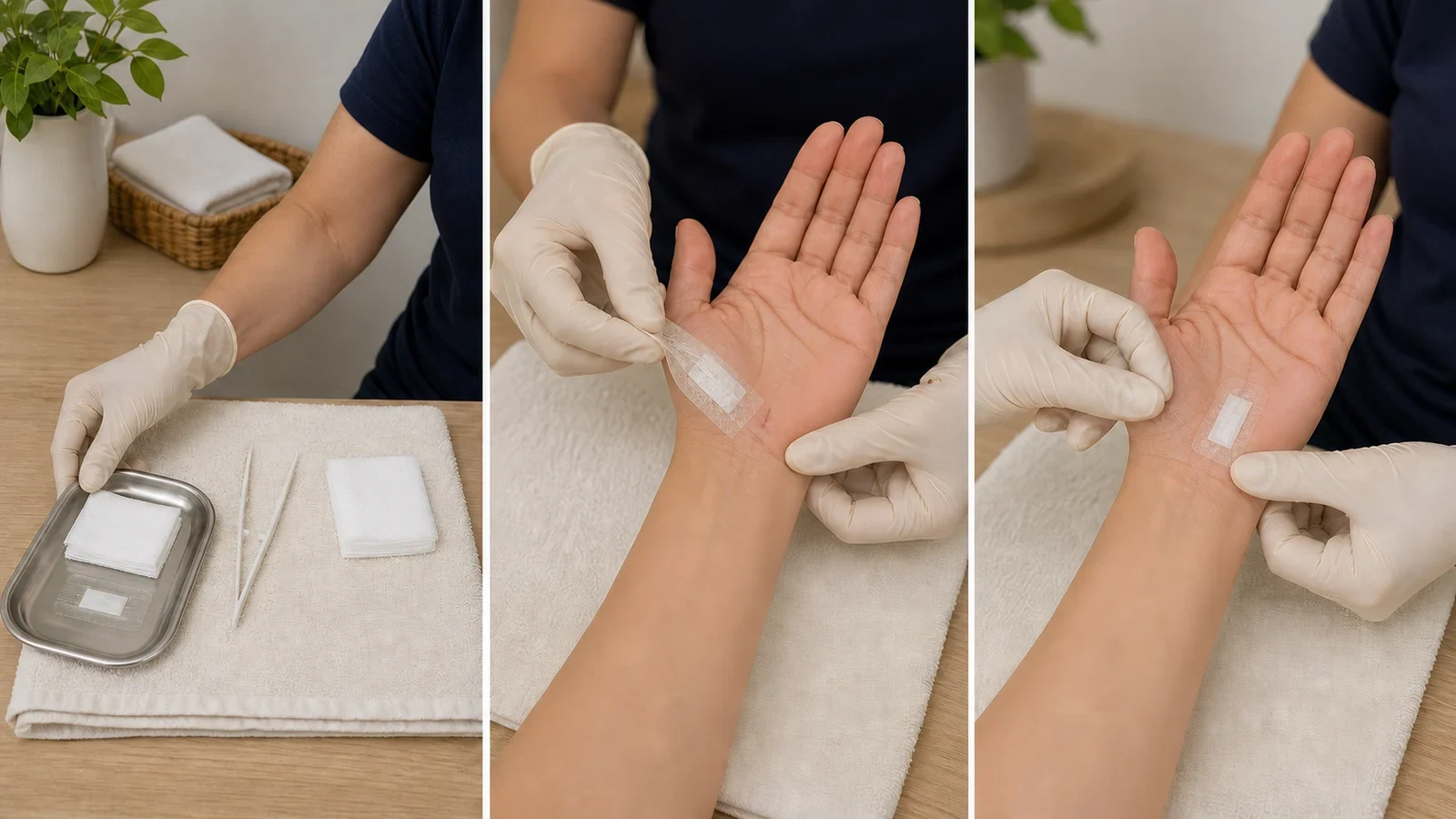
🩹 Wound care and changing the dressing
Many people feel uneasy the first time they open the dressing. What you see is a short line across the palm with its edges closely apposed, perhaps a little swollen and pinker than the skin around it; that appearance is usual in the first days. The aim is simple: keep the wound dry and clean so it can close on its own. In a randomised trial, removing the bulky dressing after 48 to 72 hours and applying a light dressing caused no extra wound complications and gave short-term results equal to keeping the dressing for two weeks; a systematic review likewise favours a short 2-to-3-day bulky dressing over a 9-to-14-day one.
More detailLess detail
- Before anything else, wash and dry your other hand thoroughly, then lay out clean supplies on a clean surface. Contamination almost always comes from a helper's hand or the work surface, not from the air.
- Lift the outer dressing away gently, along the length of the hand. If a corner has stuck, do not pull it; wait a moment and open from the other side so the wound edge is not dragged.
- Only look at the wound. Do not press along the line with a finger, do not pick the scab, and do not twist the stitches.
- Clean it only in the way your discharge sheet describes. Do not put alcohol, povidone-iodine or an ointment of your own choosing on a fresh incision; these can slow healing.
- Apply a dry, clean dressing that covers the whole line with a narrow margin, and secure it without tightness. A tight dressing makes the fingers swollen and numb.
- If the dressing becomes wet, dirty or loose, change it then and there rather than waiting for the next day. A damp dressing is a route in for bacteria.
- A small blood-tinged stain that fades daily is usual; purulent discharge, a bad smell or a dressing soaking again with fresh fluid is not, and should be reported the same day.
- Stitches are usually removed two to three weeks after surgery, at your follow-up. Do not remove them yourself.
🦾 Moving the fingers from day one
This is the single most important thing you do at home. The dressing sits on the palm, not on the fingers, so the fingers should be moving from the first hours. Holding the hand still does not help the wound, contrary to what many expect; it only leaves more stiffness and weakness behind. In trials, a routine splint after this operation gave no benefit, and a non-removable splint was even associated with weaker pinch strength at six and twelve months.
More detailLess detail
- Every hour or two while awake, close the fingers into a full fist and open them fully. "Full" means the fingertips reach the palm, and then the fingers straighten completely.
- Move the thumb separately: bring it across towards the palm, touch its tip to the tip of each finger, and bring it back.
- Circle and raise the elbow and shoulder as well. An arm that hangs at the side for days ends up with a stiff shoulder.
- Light everyday tasks such as holding a glass, doing up buttons and brushing your teeth are allowed, and are in fact useful.
- What is still too early: sustained direct pressure through the palm, such as pushing up from a chair with a flat hand, lifting heavy objects and forceful twisting.
- If moving the fingers becomes painful, or you cannot straighten one of them, stop and call the team.
🚿 Showering, waterproof cover and keeping the wound dry
Showering and soaking the hand are not the same thing. A short shower with the hand fully covered is fine, but putting the hand into water is off limits until the stitches are out and the incision line is dry and closed.
More detailLess detail
- To shower, cover the hand with a waterproof sleeve or a plastic bag sealed above the wrist, and keep it out of the direct stream.
- If the cover leaks and the dressing gets wet, replace it with a dry, clean one straight after the shower.
- Washing up, baths, swimming pools, the sea and saunas all wait until the wound is fully closed and your team agrees.
- Once the wound has closed completely, gentle scar massage with a plain cream can help soften it.
💊 Your medicines and pain control
Take only the medicines written on your own prescription. Pain after this operation is usually controlled with simple analgesia, and it peaks in the first day or two, once the local anaesthetic wears off.
More detailLess detail
- In the first days, take the painkiller on schedule rather than only when the pain peaks. Pain is easier to control when you do not let it climb.
- Take a missed dose as soon as you remember, but if the next dose is close, do not take two together.
- Before adding any over-the-counter painkiller, compare its ingredients with your own medicine; many cold remedies contain the same active drug, and taking both means a double dose.
- If you were prescribed a sedating painkiller, do not drive or operate machinery after taking it.
- Do not stop, add or change the dose of any medicine on your own.
🧊 Swelling, elevation and cold
Some finger swelling in the first days is usual, and elevation controls it better than anything else. The rule is simple: the hand above the level of the heart.
More detailLess detail
- When sitting, rest the forearm on one or two pillows. When sleeping, keep the hand raised on a pillow beside you.
- Do not let the arm hang at your side, and do not leave it still on your abdomen for hours; both make swelling worse.
- Put a cold pack on the wrist and forearm rather than directly on the dressing, and always keep a thin cloth between ice and skin.
- Take rings and bracelets off the operated hand in advance; once a finger swells, removing a ring becomes difficult and risky.
🎯 Short rehabilitation after surgery
This operation has no heavy exercise programme; the real work is moving the fingers fully. One simple exercise is worth the time.
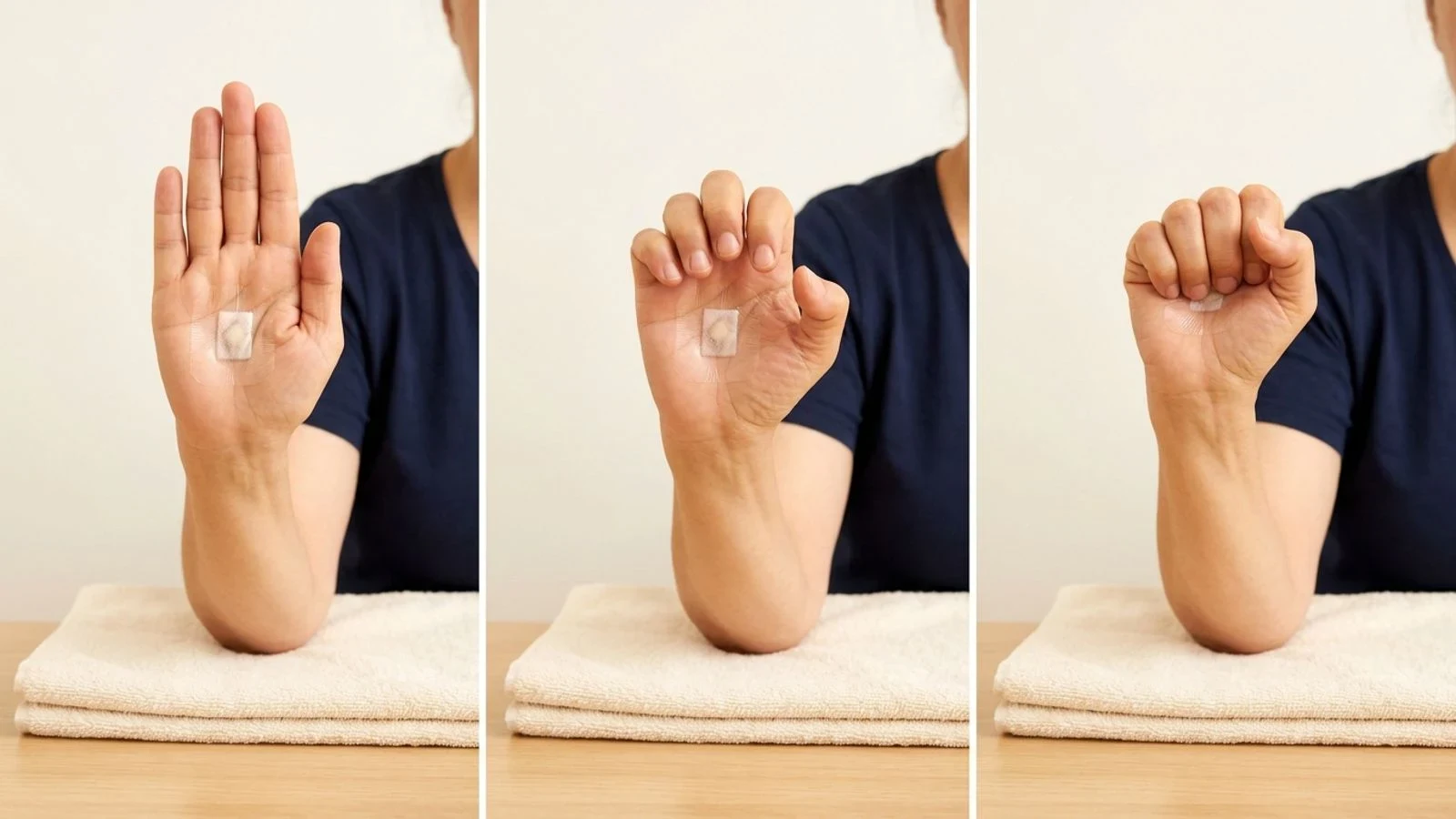
Tendon gliding (Tendon Gliding)
Move the hand through several positions so the tendons and nerve glide and stick less. Several times a day, within comfort; stop with sharp pain or new numbness.
More detailLess detail
Goal and why: the tendons and nerve must glide; stillness creates adhesion.
Stage and starting criteria: once the dressing is light and pain allows.
Equipment and safety: none; seated, forearm supported.
Starting position: forearm on a table, wrist and fingers straight.
Step by step:
- Hold the fingers straight and together.
- Bend the joints into a hook.
- Make a full fist, then return slowly.
Range, side and limits: to a mild stretch, not pain.
Breathing: calm; do not hold your breath.
Rest: a few minutes between rounds.
Stop immediately if: sharp pain, new numbness or leakage.
Common mistakes: bending the wrist instead of the fingers; a half fist.
Progression criteria: full fist and full opening without pain.
🚗 Returning to work, driving and everyday life
Returning to activity after this operation is gradual, and it follows what your hand can actually do rather than the calendar. The figures below are medians, not promises.
🗓️ The usual path of recovery
- First week: full finger movement and light use of the hand; elevation and wound care are the main work.
- Two to three weeks: stitches out at your follow-up, and freer use of the hand.
- After the stitches come out: gentle scar massage once the wound has fully closed.
- Up to about 6 months: in one trial, sensation had improved by around the second week, but strength had not fully returned until the twenty-sixth week.
💼 Work
- In a systematic review of 56 studies, the median return to non-manual work was 21 days, with a range of 7 to 41 days.
- The median return to manual work was 39 days, with a range of 18 to 101 days.
- The same review stresses how widely these figures vary, and how much they depend on the job, the dominant hand and individual circumstances.
🚗 Driving
- When you can grip the wheel firmly and painlessly, use the gears and handbrake fully, and keep control of the car in a sudden manoeuvre.
- Do not drive while you still have a bulky dressing or are taking a sedating painkiller.
🕌 Prayer
- The difficulty with prayer is prostration and getting up from the floor, because both go through the palm and press exactly where the incision is.
- While pressure on the palm still hurts, take the weight on a closed fist, the forearm or the elbow, or pray seated on a chair.
- Perform ablution with a waterproof cover and without immersing the hand in water.
💞 Sexual activity
- The restriction here is not general; it concerns the hand alone, and specifically taking weight through the operated palm.
- Choose positions in which the operated hand bears no weight and the dressing is neither dragged nor made wet.
- The simple test: any position that makes the palm hurt is still too early.
🏋️ Sport and heavy activity
- Walking and aerobic activity that does not involve the hand are fine from the first days.
- Weights, swimming, pull-ups, cycling that loads the palm and racquet sports begin with your team's agreement, once strength has returned.
❓ Frequently asked questions
1) Why are my fingers still numb even though I have had the operation?
Surgery takes the pressure off the nerve, but the nerve needs time to recover on its own. Night symptoms usually improve quickly, but if the compression lasted for years and the nerve damage was advanced, sensation can take months to return and may not return completely.
2) Do I need to wear a splint?
Normally no. In a trial of 249 patients, three regimens — no splint, a removable splint and a non-removable splint — showed no difference in outcome up to twelve months, and the non-removable group had weaker pinch strength at six and twelve months. If your surgeon has given you a splint for a specific reason, follow that instruction.
3) My palm hurts when I press on it; has something gone wrong?
Tenderness on either side of the incision when leaning or pressing is the most common complaint after this operation, and it usually settles over weeks. Until then, take weight on a closed fist or the forearm instead of the flat palm. Pain that worsens daily, or comes with redness and fever, is a different matter and needs review.
4) When can I put my hand in water?
Not until the stitches are out and the incision line is completely dry and closed. A short shower with a waterproof cover is a separate question and is fine.
5) How long does the dressing stay on?
The initial bulky dressing is usually needed for the first few days. In a randomised trial, removing it after 48 to 72 hours and applying a light covering caused no extra wound complications and gave short-term results equal to keeping it for two weeks. Take the exact timing from your own discharge sheet.
6) Do I need physiotherapy?
Not routinely. A Cochrane review of 22 trials and more than 1500 patients found the evidence for rehabilitation interventions after this operation to be limited and largely of low quality. Referral to hand therapy for a hand that stays stiff or does not recover is an individual decision.
7) When can I drive?
Once the bulky dressing is off, you are no longer taking a sedating painkiller, and you can grip the wheel firmly and painlessly and keep control of the car in a sudden manoeuvre. This ability returns at different times in different people.
8) When will I go back to work?
In a review of 56 studies, the median return was 21 days for non-manual work and 39 days for manual work, but both ranges were wide. The type of job, the dominant hand and how much your work loads the palm all matter.
9) Why is my grip still weak?
In one trial, patients' sensation had improved by around the second week but strength had not fully returned until the twenty-sixth week. Some weeks of weakness after this operation are usual, and strength returns with gradual use and without sudden loading.
10) Can I sleep on the operated hand?
In the first days it is better to keep the hand on a pillow above the level of your heart so that swelling settles. Sleeping with your full weight on the operated palm is both painful and likely to displace the dressing.
11) If both my hands are affected, should they be operated on together?
That decision depends on how severe the symptoms are on each side, on your job and on your circumstances at home. This article is written for one-sided surgery; if bilateral surgery is being considered, the care plan and the help you will need at home should be discussed separately with your surgeon.
12) Can I remove the stitches myself?
No. Stitches are usually removed by the team two to three weeks after surgery, at your follow-up. Removing them early or at home raises the risk of the wound opening and of infection.
13) How long will the scar last?
The line is raised and pink at first, and fades and softens over months. Once the wound has fully closed, gentle daily massage with a plain cream helps it soften.
14) What is the risk of infection?
Infection after this operation is rare. In the same trial of 249 patients, there was one wound infection, which resolved with oral antibiotics, and two cases of superficial wound separation. Even so, spreading redness, purulent discharge or fever should be reported the same day.
15) Could this operation ever be needed again?
In most people the result is durable. Recurrent symptoms can have several causes, from incomplete release to another underlying condition, and assessing them needs examination and sometimes a repeat nerve conduction study rather than guesswork from symptoms.
16) Do smoking or diabetes affect wound healing?
Yes. Tobacco use and uncontrolled blood sugar both slow wound healing and raise the risk of infection. Controlling your sugar over these few weeks, and cutting down or stopping tobacco, directly benefits this wound.
✅ Summary
Carpal tunnel release is a small operation with simple aftercare. If it all had to fit in one sentence: keep the wound clean and dry, keep the hand up, move the fingers fully, and give yourself a few weeks for strength to come back. A routine splint and routine physiotherapy are not needed here, and holding the hand still creates more stiffness than it prevents.
If you have questions about your own wound, remaining numbness or when you can go back to work, book an appointment for an individual assessment.
Learn more about this area of care on the Peripheral Nerve page.
This content is for general education only and does not replace examination, the advice of your treating doctor, your discharge sheet or your surgeon's specific protocol. Timing, range of motion, loading and exercise dose vary with the type of operation, any procedures done at the same time and each person's circumstances. Do not change your medicines, your dressing or your exercise programme without consulting your care team.
📚 Scientific sources
View the scientific sources
- Graham B, Peljovich AE, Afra R, et al. The American Academy of Orthopaedic Surgeons Evidence-Based Clinical Practice Guideline on: Management of Carpal Tunnel Syndrome. J Bone Joint Surg Am. 2016;98(20):1750-1754. doi:10.2106/JBJS.16.00719
- Peters S, Page MJ, Coppieters MW, Ross M, Johnston V. Rehabilitation following carpal tunnel release. Cochrane Database Syst Rev. 2016;2(2):CD004158. doi:10.1002/14651858.CD004158.pub3
- Ritting AW, Leger R, O'Malley MP, Mogielnicki H, Tucker R, Rodner CM. Duration of postoperative dressing after mini-open carpal tunnel release: a prospective, randomized trial. J Hand Surg Am. 2012;37(1):3-8. doi:10.1016/j.jhsa.2011.10.011
- Logli AL, Bear BJ, Schwartz EG, Korcek KJ, Foster BJ. A Prospective, Randomized Trial of Splinting After Minicarpal Tunnel Release. J Hand Surg Am. 2018;43(8):775.e1-775.e8. doi:10.1016/j.jhsa.2018.01.016
- Svegard J, Nordvall Persson A, Zetterlund C, Alkner B. Comparison of use of plaster casting versus elastic bandage following carpal tunnel release: a randomized controlled study. J Rehabil Med. 2021;53(3):jrm00168. doi:10.2340/16501977-2788
- Huisstede BM, van den Brink J, Randsdorp MS, Geelen SJ, Koes BW. Effectiveness of Surgical and Postsurgical Interventions for Carpal Tunnel Syndrome - A Systematic Review. Arch Phys Med Rehabil. 2018;99(8):1660-1680.e21. doi:10.1016/j.apmr.2017.04.024
- Newington L, Stevens M, Warwick D, Adams J, Walker-Bone K. Sickness absence after carpal tunnel release: a systematic review of the literature. Scand J Work Environ Health. 2018;44(6):557-567. doi:10.5271/sjweh.3762
- Atlan F, Ashkenazi I, Shehadeh K, et al. Early postoperative dressing removal in hand surgery: Novel concepts for individualized surgical dressing management. Hand Surg Rehabil. 2021;40(4):389-393. doi:10.1016/j.hansur.2021.03.011
- Virtos M, Chassery C, Marty P, et al. Wide awake local anesthesia no tourniquet (WALANT) versus ultrasound-guided axillary block in carpal tunnel release: a non-inferiority randomized controlled trial. Reg Anesth Pain Med. 2025. doi:10.1136/rapm-2025-107152

Dr. Jalil Emad
Orthopedic specialist and surgeon, board-certified in bone and joint surgery; years of experience in knee and hip replacement, sports injuries and arthroscopy in Isfahan.
Related articles
Latarjet Shoulder Surgery: Postoperative Care and Rehabilitation
A complete, criteria-based guide to surgery day and care after Latarjet shoulder surgery—from wound care, sling use, medicines, and warning signs to the first 90 days of rehabilitation and a safer return to activity.
Arthroscopic Rotator Cuff Tendon Repair Surgery: Postoperative Care and Rehabilitation
A complete, criteria-based guide to care after arthroscopic rotator cuff repair—from dressing changes, sling use, and warning signs to the first 90 days of rehabilitation and a safer return to activity.

Total Hip Replacement Surgery: Postoperative Care and Rehabilitation
A complete, criteria-based guide to surgery day and care after total hip replacement—from wound care, medicines, and warning signs to the first 90 days of rehabilitation and a safer return to activity.