
On this page
Other orthopaedic operations: a shared care guide
This guide explains wound, dressing, splint, cast and medicine care after orthopaedic operations without a dedicated article.
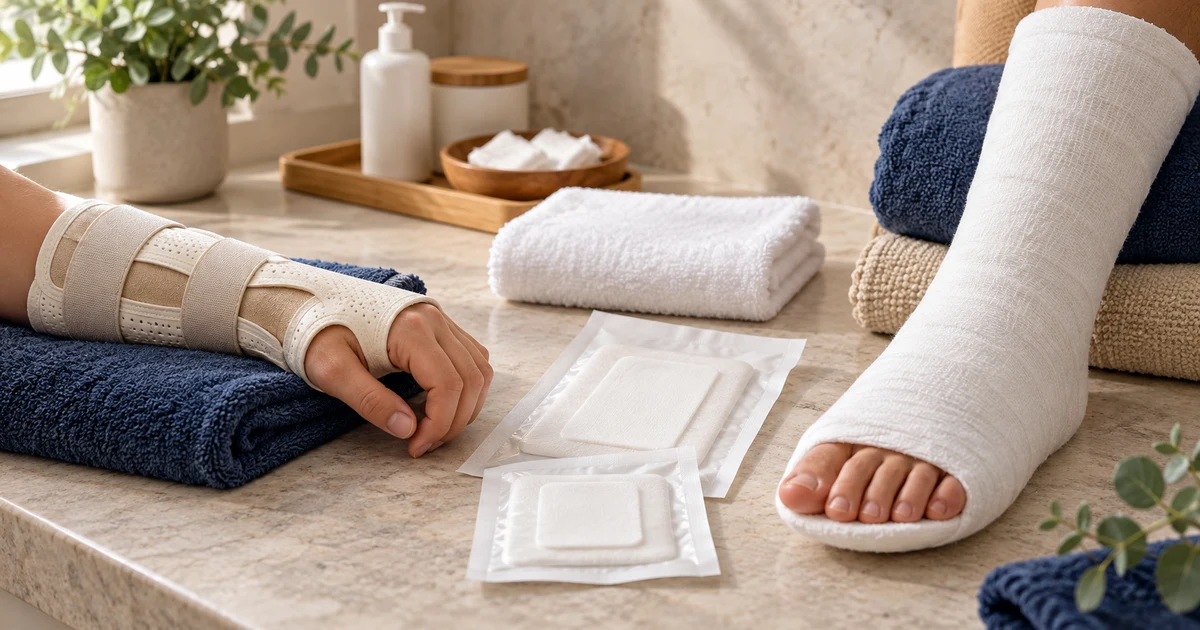
🏥 The day of surgery and going home
This guide is for shared care after orthopaedic operations that do not yet have a dedicated article. Questions about your wound, support or daily activities are natural in the first days; simple care and a clear plan can make looking after yourself easier.
Your operation may have used local anaesthesia, a nerve block or general anaesthesia. While the limb is numb, protect it from pressure, direct heat and knocks. Absence of pain during this time does not mean the limb is ready for use or walking.
Discharge depends on your operation and condition. Before going home, pain and nausea should be manageable, and you should have learned to use your crutches, walker or arm sling safely. After general anaesthesia or sedation, have someone take you home and an adult stay with you for the first 24 hours.
Some pain, bruising and swelling near the operation site can be expected. The overall trend should improve with rest, care and prescribed medicine; do not automatically put increasing pain or a new symptom down to the operation.
⚠️ Warning signs: what should you do?
Contact your surgeon or treatment centre the same day: spreading redness or warmth, pus or foul-smelling discharge, or the wound opening; temperature of 38°C or higher, or chills; increasing pain despite your prescribed medicine; new tingling or burning under the splint; call now for advice; a wet or blood-stained dressing with a spreading stain; a wet, softened, broken or loose cast or splint; new pain and swelling in one calf; seek assessment the same day; a fall or knock to the operated limb.
Get emergency help: sudden breathlessness, chest pain, coughing up blood or fainting; cold, pale or blue fingers or toes; new persistent or worsening numbness; new inability to move the digits; or severe ongoing pain with a feeling of pressure; heavy or ongoing bleeding that direct pressure over the dressing does not control; swelling of the face or tongue, or difficulty breathing after taking medicine; extreme drowsiness with difficulty waking, or slow, shallow breathing after a strong painkiller or sleeping medicine. In Iran, call the medical emergency service on 115.
For questions about your dressing, limb support or medicines, call Dr Jalil Emad’s clinic on 0913 782 5207, or book an appointment online. In an emergency, do not wait for the clinic to reply; follow the instructions in the emergency box above.
1General postoperative care at home
You do not have to manage everything alone from the first day. Ask your companion to help with medicines, travel and dressing care, and rest between activities.
🩹 Wound care, dressings, showering and routine review
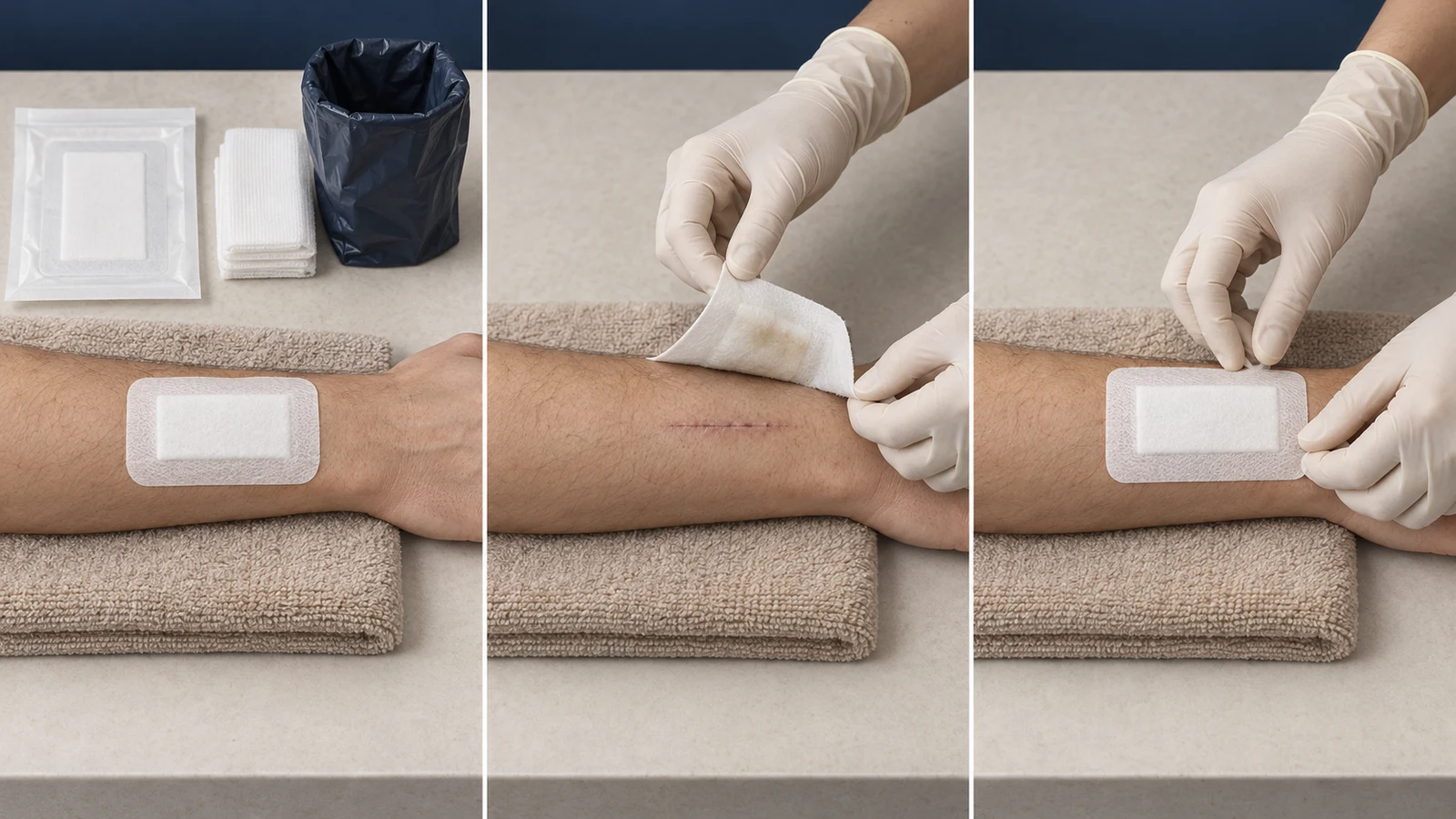
A clean, dry dressing protects the wound; you do not need to open it daily to inspect the wound. A small stable stain is different from a soaked dressing or a growing stain. The method below applies when you have been taught and authorised to change the dressing at home.
More detailLess detail
- Check when the first change is due. Do not open a dressing under a cast or fixed splint, a compression bandage, a suction dressing or a specialist dressing yourself; the treatment team must attend to it.
- For an authorised home change, wash your hands with soap and water and prepare the new dressing, sterile gauze and a waste bag on a clean surface. Do not touch the inner surface of the gauze or dressing.
- Gently loosen the old adhesive from the skin. Do not disturb sutures, staples, skin glue or closure strips. If the dressing has stuck to the wound, do not pull it off; get advice on safe removal.
- Discard the old dressing and wash your hands again. If contact with the wound area is needed, use sterile gloves as taught. Clean only with the recommended method and solution; do not apply alcohol, hydrogen peroxide, iodine antiseptic, ointment or herbal remedies on your own.
- Position the fresh dressing so its soft absorbent pad covers the wound and the adhesive rests only on surrounding skin. Do not wrap it tightly around the limb. If discharge soaks it or the stain keeps spreading, repeated changes should not replace wound assessment.
- If water has entered an ordinary dressing, replace it with a dry one using the method you were taught. If you are not authorised to change it, or the wound is under a splint or cast, arrange help the same day.
- Many closed surgical wounds may be showered after 48 hours; this is not permission to shower with every operation, dressing or cast. Until your own permitted time, wash your body with a damp cloth while keeping the operation site dry.
- Once showering is allowed, keep it brief and avoid a strong water jet onto the wound. A dressing is waterproof only if its type is confirmed and all its edges are fully sealed to the skin. Steam, loosened adhesive or water ingress can compromise that protection.
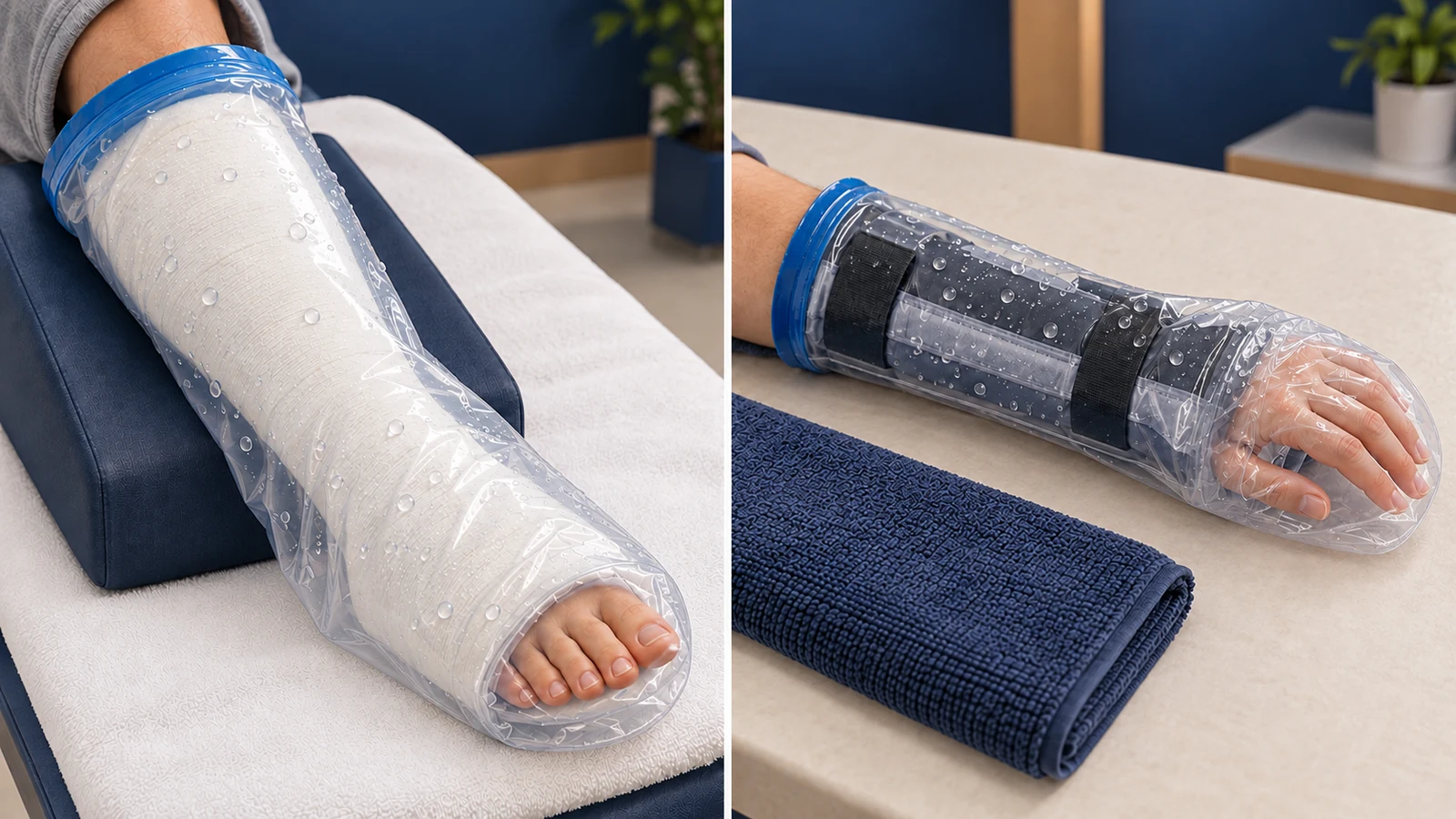
- Cover the splint or cast with a suitable waterproof cover or protector, and keep the limb away from direct running water. A cover or a fibreglass cast alone does not make the lining waterproof. If there is dampness underneath after showering, treat it as a wet dressing or cast.
- Do not immerse the operation site until the wound is fully closed and bathing or swimming is permitted. Do not put an ordinary cast or splint in a bath, basin or pool, even with a cover.
- Routine clinic review is one to two weeks after surgery, to check the wound, dressing and limb support and clarify the next step. Attend even if you feel well; if a different time was set for your own operation, follow that appointment.
- If no review date was given, contact the clinic on the first working day after discharge to arrange a definite appointment. Do not wait for routine review for a new problem; urgent situations are explained in the warning-signs section.
- Bring your discharge sheet, prescription and current medicine list, operation report and any requested imaging. Write down questions about movement, work, your support and medicines.
- Absorbable sutures, removable stitches, staples and skin glue need different care. Removal of stitches or staples depends on the site and healing; do not remove them yourself. Do not trim visible glue or thread either.
- Follow-up imaging and starting physiotherapy are not needed, or timed alike, for every operation. Follow any imaging request or physiotherapy referral you have; little pain or closed skin does not mean deeper tissues have finished healing.
🦾 Splints and casts: care and what to do if they get wet
Splints and casts protect healing tissue. Less pain alone does not give permission to remove them. Even with a firm outer shell, damp padding underneath can irritate the skin.
More detailLess detail
- Do not cut, trim or remove a fixed splint, cast or retaining bandage yourself. Remove a removable splint or special limb support (brace) only at the permitted times; hook-and-loop straps do not mean removal is allowed.
- Check the skin at the edges and the exposed fingers or toes daily. Keep rings and jewellery away from the swollen limb. Do not insert anything to scratch underneath, or put powder, oil or cream inside.
- If only the outside of the protective cover is wet and the cast or splint and lining stayed dry, gently remove the cover and dry its outside with a towel. A wet cover is different from a wet cast.
- If the splint itself, its padding or the dressing underneath is wet, support the limb and contact the clinic or casting service the same day for assessment and possible replacement. Do not open a fixed splint to dry it. With a removable splint, follow only a specific method already taught to you.
- If the cast itself is wet, do not bear weight on it and call the same day for assessment; plaster may soften, and the lining of a fibreglass cast can remain damp too. Do not assume a softened, cracked, foul-smelling cast or one with wet lining is reliable at home.
- Do not use a hot hairdryer, heater, iron or direct heat to dry it. A dry-looking cast does not prove the padding is dry, and home drying does not replace assessment of a wet cast.
- If your treatment team explicitly confirms that both the cast material and lining are waterproof, follow the washing and drying instructions for that cast only. Colour, light weight or fibreglass construction alone is not that confirmation.
- Night-time use, strap adjustment and removal depend on the repair. If these instructions are missing, keep the support in its prescribed position while you clarify the plan with the clinic.
🧊 Pain, swelling and rest
The aim is enough pain control to rest and do permitted activities. After a busy day, some rest and elevating the limb can help reduce swelling.
More detailLess detail
- Support the limb on pillows in its permitted position, above heart level where possible. For a leg, support it under the calf; for an arm, support the forearm. Keep the limb supported and avoid direct pressure on the wound or cast edge.
- If cold therapy is allowed, use a leakproof cold pack with a cloth layer for no more than 20 minutes. Check the skin; if it becomes painful or burns, remove the cold pack and stop using it. Let the skin return to its usual temperature before repeating. Do not apply cold yourself to numb skin or an area with poor circulation; ask the treatment team about a suitable method.
- Do not put an ice pack under the dressing or inside the splint, and keep meltwater off the cast. Do not leave a cold pack on the limb while asleep.
- Rest between activities, but do not stay in bed all day without a reason. Keep permitted movements and transfers short and safe; more pain or swelling after activity is a reason to reduce the load and return to your previous level.
💊 Medicines and supplements: purpose and safe use and PRP
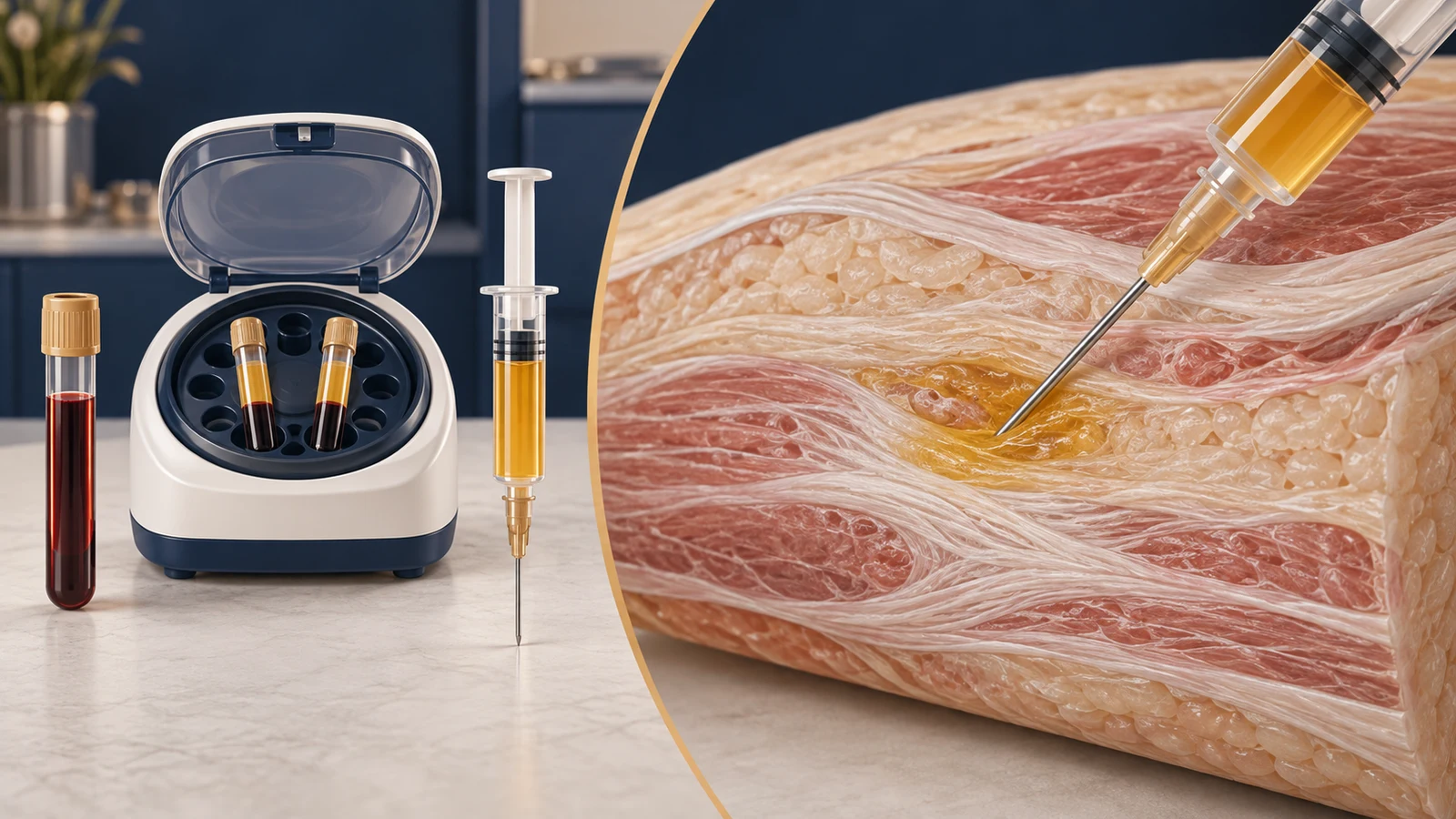
Antibiotics, paracetamol–codeine, famotidine, alprazolam, vitamin C and collagen have different roles. These explanations help you understand your own prescription; you do not need to take all of them. Dose, intervals and duration must come from your own prescription. Platelet-rich plasma (PRP) is prepared from a small sample of your own blood. Platelets contain growth factors; the aim is to support natural tissue healing and, in suitable cases, bone healing.
More detailLess detail
- Your schedule: note each medicine’s name, dose, dose times and final day. For a missed dose, use that medicine’s leaflet or ask a pharmacist; medicines do not all share one rule, and you should not double the amount yourself to compensate.
- Antibiotics are prescribed to prevent or treat infection in specific situations and are not needed for every operation. Follow the prescribed medicine, intervals, food instructions and duration. Do not stop yourself because you feel better or extend the course afterwards; contact the treatment team the same day for an allergic reaction or severe diarrhoea; breathing difficulty or facial swelling needs the action in the warning-signs section.
- Paracetamol (acetaminophen) with codeine is a combination painkiller; codeine can cause drowsiness, nausea and constipation. Check the paracetamol content of all medicines you take together to avoid duplication. Do not drink alcohol with it or drive while drowsy. Keep it out of children’s reach.
- Alprazolam treats anxiety and has a sedating effect; it is not a painkiller or wound-healing medicine. Combining it with paracetamol–codeine requires an explicit, medically assessed plan; spacing them a few hours apart alone does not make the combination safe. If you already take alprazolam regularly, do not stop suddenly; coordinate any change with your clinician. Do not take alcohol or add another sleeping medicine yourself while taking it.
- Famotidine reduces stomach acid and is taken for the reason on your prescription; it may be taken with or without food. It does not prevent every stomach problem or eliminate bleeding risk from painkillers and anticoagulants. Tell your clinician if you have kidney disease, because the dose or interval may need adjustment.
- Vitamin C is needed to make collagen and support normal healing. If a supplement is prescribed, take that amount; adequate intake and correcting deficiency matter, but higher doses do not mean faster healing for everyone. Mention kidney stones or kidney disease before taking high doses.
- Collagen is a protein supplement and should be used in the amount on the product instructions or prescription. Evidence of improved outcomes is not consistent or conclusive across all operations; taking it does not guarantee bone or wound healing and does not replace a balanced diet with enough protein. Check its ingredients and source, especially with food allergies.
- Other painkillers and medicines: check interactions with your pharmacist or clinician before adding ibuprofen, diclofenac, naproxen, aspirin, sleeping medicine or a new supplement, particularly if you take an anticoagulant. Do not substitute someone else’s medicine or leftovers from previous treatment for your prescription.
- Children, pregnancy and breastfeeding: this section is not a child’s medicine plan. Paracetamol–codeine must not be given to a child under 12 years and has restrictions for some adolescents; children need medicines prescribed for their age and weight. During pregnancy or breastfeeding, clarify use of these medicines with your clinician before starting. Codeine is not recommended during breastfeeding; arrange a suitable alternative painkiller before taking it. Also tell your clinician about respiratory disease or sleep apnoea.
- For selected orthopaedic operations, Dr Emad may consider PRP to support tendon, soft-tissue or bone healing. In a study of patients with tibial nonunion, PRP used alongside fracture fixation and bone grafting was associated with a shorter healing time; this finding cannot be applied to every orthopaedic operation. If suitable for you, treatment details are decided at your visit; continue your postoperative care plan.
🫀 Clot prevention after lower-limb surgery
Clot prevention is not the same for every leg operation; the operation, immobility and bleeding risk affect the decision. If medicine was prescribed for you, follow that prescription’s dose and duration precisely.
More detailLess detail
- If an anticoagulant is prescribed, follow its dose, timing and duration precisely; feeling better or walking more is not a reason to stop early. Do not replace a prescribed injection or anticoagulant tablet with aspirin.
- If you have had lower-limb surgery, have a cast or are not allowed to bear weight, and your prescription does not clearly set out clot prevention, contact the clinic the same day. Do not start medicine yourself while the plan is being clarified.
- Tell the treatment team about previous clots or bleeding, kidney disease, pregnancy, cancer or hormonal medicines. The need for and choice of an anticoagulant must be assessed for your own situation.
- If you miss a dose, do not double the next one on your own. Give the pharmacist or treatment team the medicine name and time of the missed dose to obtain the instructions for that medicine; there is no single rule for all anticoagulants.
- Help circulation with permitted activity and enough water if you have no fluid restriction. Move free fingers or toes, or the ankle, only when your operation instructions allow it and the splint restrictions do not prohibit it; movement and water do not replace a prescribed anticoagulant.
🚶 Returning to activity after other operations
There is no shared safe exercise or weight-bearing timetable for this group of operations. Removing a small lesion, repairing a tendon and fixing a fracture may leave similar-looking wounds, but their tolerance of movement and load differs.
If your instructions say “non-weight-bearing”, do not put body weight on the operated foot and use the aid you were taught to use. With “partial weight-bearing”, the allowed amount must be clear; do not guess. “Weight-bearing as tolerated” is permitted only when explicitly prescribed for you.
- For an arm or shoulder, permission to move the fingers does not mean you may lift a load, support body weight on the hand or remove the sling. After a tendon repair, even some simple movements need a specific plan.
- Make your home safe to move around: remove loose rugs and cables from the route, keep essentials nearby, and get help with stairs or bathing. Do not hop on one foot without the walking aid and method you were taught or use a wheeled chair as a support.
- Stop using crutches, a walker, brace or sling only when permitted and when movement is possible without instability or a fall risk. Do not substitute exercises from another operation's article for your own plan.
🚗 Sleep, food, work and everyday life
Sleep and appetite may be different in the first days. Small meals, rest in a comfortable position and your companion's help can make this easier; the aim is a gradual return to permitted activities.
- 🛏️ Sleep: avoid lying on the wound or operated limb and keep the prescribed support in place. If a sling or brace must stay on at night, do not remove it yourself for comfort.
- 🥗 Food and water: eat a normal balanced diet with enough protein; eggs, dairy, pulses, meat or fish are common options. Special supplements are not needed for everyone. With diabetes, monitor glucose as planned, and follow any dietary or fluid restrictions for your medical conditions.
- 🚬 Smoking: avoid cigarettes and other tobacco; they can slow wound and bone healing. Ask the treatment team for help to quit.
- 🚗 Driving: do not drive for at least 24 hours after general anaesthesia or sedation; reaching that time alone does not permit driving after limb surgery. Do not drive while sedating medicine, inability to control steering or braking, or a restrictive splint or cast affects you. Returning requires full control and permission appropriate to the operation.
- 💼 Work and sport: desk work and physical work do not share one return date. Start with short permitted work, with opportunities to rest and elevate the limb. Do not begin weights, running, jumping or contact activities before permission for that stage.
- 🕌 Prayer: use a seated position or chair if bending the limb, leaning on the hand or sitting on the floor conflicts with your restrictions. Do not wet the dressing or cast for ablution; ask your religious authority about an alternative method.
- 🤍 Sexual activity: when fully alert and comfortable and able to respect movement and load restrictions, decide on appropriate timing for your own operation. Choose a position that avoids pressure on the wound or twisting the limb; stop if it hurts.
❓ Frequently asked questions
1) Should I open the dressing every day to look at the wound?
No. Change a clean, dry and intact dressing only when recommended. Opening it just to inspect the wound is unnecessary. If home changes are permitted, use the wound-care method above; do not open a dressing beneath a cast or fixed splint yourself.
2) Can I let a wet dressing dry on its own?
If water has entered an ordinary dressing, do not assume it is dry or usable. If authorised and trained, replace it with a dry one; otherwise arrange help the same day. A wet outer surface of an intact waterproof dressing, with no water inside, is different from a wet pad.
3) My splint is wet; should I remove it?
Do not remove a fixed splint yourself. Support the limb and arrange assessment and possible replacement the same day. A removable splint is taken off only with permission and the method taught. If only the outer cover is wet and the splint stayed dry, removing and drying the cover is enough.
4) My cast is wet; is a hairdryer enough?
Do not use a hot hairdryer; a dry appearance does not prove the lining is dry. Do not bear weight on the wet cast, and call the same day for assessment. If the treatment team confirms both the cast and lining are waterproof, follow that cast's instructions.
5) When may I shower?
Many closed surgical wounds may be showered after 48 hours; your own permission depends on the wound and dressing. Ordinary casts and splints must stay dry. Until your permitted time, clean your body with a damp cloth; afterwards, take a brief shower with an intact protector.
6) Is a small blood stain on the dressing worrying?
A small stain that does not grow can occur after surgery. Watch its size and change without opening the dressing just to inspect the wound. A soaked dressing, spreading stain or continued bleeding needs the action described in the warning-signs section.
7) When should my stitches be removed?
First establish whether your stitches are absorbable or need removal; staples and glue have different care. One fixed day is not correct for every surgical site. Attend on the date set for wound review or stitch removal; if none was given, arrange it with the clinic. Do not pull out thread yourself.
8) Do I still need postoperative review if I feel well?
Yes. Routine clinic review is one to two weeks after surgery and does not depend only on pain. Arrange the appointment on the first working day after discharge. If you were given a different individual appointment, keep it; do not wait until that appointment if a new problem appears.
9) Does every leg operation need an anticoagulant?
The need is not the same for everyone. Take prescribed medicine precisely; if you have lower-limb surgery, a cast or a non-weight-bearing restriction and no clear anticoagulant plan, contact the clinic the same day. Do not start aspirin or another medicine yourself.
10) What should I do about a missed anticoagulant dose?
Do not double the next anticoagulant dose yourself. Check the medicine name, dose and missed time, and ask your pharmacist or treatment team for that medicine's instructions. Different injections and tablets have different advice; the medicine name is necessary for a precise answer.
11) May I add another painkiller to my prescription?
Check with your pharmacist or treatment team first. Medicines may share ingredients and duplicate paracetamol (acetaminophen); some painkillers also increase bleeding risk with anticoagulants. Do not increase medicine yourself for uncontrolled pain.
12) Is cold therapy or elevation better for swelling?
Both can help when permitted. Elevate the supported limb and use a dry cold pack with a cloth for no more than 20 minutes. If the skin becomes painful or burns, remove the cold pack and stop using it. Do not apply cold yourself to numb skin, and keep meltwater away from dressings and casts.
13) May I walk on my foot if it does not hurt?
Only if weight-bearing has been allowed. Healing bone or tendon may still need protection despite less pain. Non-weight-bearing, partial weight-bearing and weight-bearing as tolerated are explained in the activity section; clarify any unclear amount with the clinic.
14) Should I keep my splint or sling on at night?
Yes, if night-time use was prescribed. There is no shared answer for every operation. Until your plan is clear, keep the support in its prescribed position and clarify night-time instructions. Easily opened straps do not mean removal is permitted.
15) When can I drive again?
Do not drive for at least 24 hours after general anaesthesia or sedation, or while sedating medicines affect you. After limb surgery, full steering and braking control and compatibility with support restrictions are also necessary; no fixed day fits every operation.
16) Must I wait for stitch removal before returning to work?
Stitch removal is not the only criterion. Work must fit your load and movement restrictions and allow wound care and rest. Physical work, lifting and prolonged standing usually need separate assessment; set the plan for your own work.
17) Do collagen and vitamin C make the wound heal faster?
Vitamin C is needed to make collagen and support normal healing, and correcting deficiency matters; more does not mean faster recovery for everyone. Collagen supplements also do not have one reliable, guaranteed benefit across all operations. If prescribed, follow the prescribed amount and keep a balanced diet with enough protein.
18) What helps constipation after painkillers?
Allowed fluids, fibre-rich food and permitted activity can help. Ask about a stool softener appropriate to your medicine. If you have severe or persistent abdominal pain, vomiting or inability to pass wind, seek medical assessment right away; do not assume it is ordinary constipation.
19) May I sit on the floor for prayer?
Only if sitting down and getting up do not breach your movement and weight-bearing restrictions. Otherwise use a chair, and do not wet the cast or dressing for ablution. Ask your religious authority about the alternative method.
20) When can I resume sexual activity?
A fixed date is not suitable for every operation. You need full alertness, comfort and respect for load and movement restrictions. Choose a position without pressure on the wound or twisting the limb, and stop if it hurts; clarify timing at review if your operation has specific restrictions.
✅ Regular care with a few clear steps
Keep your wound and support clean and dry, take medicines as prescribed, use only permitted loads and movements, and attend your planned review. You do not have to manage recovery alone; keep your operation name and discharge instructions handy when asking a specific question, so the answer fits your situation.
If you have signs requiring same-day advice in the warning box, call the clinic that day and do not wait for a booked appointment. For questions about review timing, splint use or return to work, call Dr Jalil Emad’s clinic on 0913 782 5207, or book an appointment online. In an emergency, do not wait for the clinic to reply; follow the instructions in the warning signs section.
For more about orthopaedic injury treatment, see Trauma and limb reconstruction.
This content is for general education and does not replace examination, advice from your treating clinician, discharge instructions or your surgeon’s specific protocol. Timing, range of movement, weight-bearing and exercise amounts vary with the operation, additional procedures and individual circumstances. Do not change medicines, dressings or exercise plans without coordinating with your treatment team.
📚 Scientific references
View guidance sources
- MedlinePlus: Surgical wound care - closed. https://medlineplus.gov/ency/patientinstructions/000738.htm
- NICE: Surgical site infections: prevention and treatment (NG125), Recommendations. https://www.nice.org.uk/guidance/ng125/chapter/Recommendations
- Guy’s and St Thomas’ NHS Foundation Trust: Caring for your surgical wound at home. https://www.guysandstthomas.nhs.uk/health-information/caring-your-surgical-wound-home
- AAOS OrthoInfo: Care of Casts and Splints. https://www.orthoinfo.org/recovery/care-of-casts-and-splints/
- York and Scarborough Teaching Hospitals NHS Foundation Trust: Plaster cast care. https://www.yorkhospitals.nhs.uk/seecmsfile/?id=2627
- Gloucestershire Hospitals NHS Foundation Trust: Care of your cast. https://www.gloshospitals.nhs.uk/your-visit/patient-information-leaflets/care-your-cast/
- Royal Wolverhampton NHS. Knee arthroscopy: exercise and guidance, cold-therapy precautions (institutional postoperative guidance; cautiously adapted here). https://royalwolverhampton.nhs.uk/wp-content/uploads/2026/01/Knee_Arthroscopy_Exercise_and_Guidance.pdf
- South Tees Hospitals NHS Foundation Trust: Peripheral nerve block. https://www.southtees.nhs.uk/resources/peripheral-nerve-block/
- Kingston and Richmond NHS. After an anaesthetic and sedation: Day Surgery Unit (updated July 2026). https://www.kingstonandrichmond.nhs.uk/patients-and-families/patient-leaflets/after-anaesthetic-and-sedation-day-surgery-unit
- Royal Free London NHS. Preventing surgical site infections (approved April 2026). https://www.royalfree.nhs.uk/patients-and-visitors/patient-information-leaflets/preventing-surgical-site-infections/submit/43795
- NICE: Venous thromboembolism in over 16s (NG89), Recommendations. https://www.nice.org.uk/guidance/ng89/chapter/Recommendations
- NHS: Anticoagulant medicines. https://www.nhs.uk/medicines/anticoagulants/
- MedlinePlus: Acetaminophen. https://www.medlineplus.gov/druginfo/meds/a681004.html
- NHS: Ibuprofen for adults. https://www.nhs.uk/medicines/ibuprofen-for-adults/
- MedlinePlus: Pain medications - narcotics. https://medlineplus.gov/ency/article/007489.htm
- NHS. Having surgery: after surgery. https://www.nhs.uk/tests-and-treatments/having-surgery/afterwards/
- AAOS OrthoInfo: Rotator Cuff Tears: Surgical Treatment Options. https://www.orthoinfo.org/treatment/rotator-cuff-tears-surgical-treatment-options/
- Mid and South Essex NHS Foundation Trust: Broomfield Orthopaedic Virtual Fracture Clinic. https://www.mse.nhs.uk/broomfield-orthopaedic-virtual-fracture-clinic
- Royal National Orthopaedic Hospital. Eating well before and after surgery: a patient guide. https://www.rnoh.nhs.uk/patients-and-visitors/patient-information-guides/eating-well-before-and-after-surgery-patients-guide
- AAOS OrthoInfo: Smoking and Musculoskeletal Health. https://www.orthoinfo.org/staying-healthy/smoking-and-musculoskeletal-health
- NIDDK, NIH. Symptoms and causes of constipation. https://www.niddk.nih.gov/health-information/digestive-diseases/constipation/symptoms-causes
- NHS: DVT (deep vein thrombosis). https://www.nhs.uk/conditions/deep-vein-thrombosis-dvt/
- MedlinePlus, NIH. Opioids and opioid use disorder: overdose warning signs. https://medlineplus.gov/opioidsandopioidusedisorderoud.html
- NHS: Antibiotics. https://www.nhs.uk/medicines/antibiotics/
- NHS: Antibiotics - Interactions. https://www.nhs.uk/medicines/antibiotics/interactions/
- MedlinePlus: Acetaminophen and Codeine. https://medlineplus.gov/druginfo/meds/a601005.html
- DailyMed, US National Library of Medicine: Alprazolam tablet: prescribing information. https://www.dailymed.nlm.nih.gov/dailymed/drugInfo.cfm?setid=8d76a554-7ed1-4c93-a5ea-30898aec0aa1
- DailyMed, US National Library of Medicine: Famotidine tablet, coated: prescribing information. https://dailymed.nlm.nih.gov/dailymed/drugInfo.cfm?setid=fd5d15b9-b1b5-48ef-ba41-8a43a7642e94
- NIH Office of Dietary Supplements: Vitamin C: Fact Sheet for Health Professionals. https://ods.od.nih.gov/factsheets/VitaminC-HealthProfessional/
- Bechara, Flood and Gunton; Antioxidants: A Systematic Review on the Role of Vitamin C in Tissue Healing. https://pubmed.ncbi.nlm.nih.gov/36009324/
- Latini et al.; Frontiers in Medicine: Clinical evidence for low-molecular-weight collagen peptides in tendon and ligament tears: a systematic review with narrative synthesis. https://pubmed.ncbi.nlm.nih.gov/42666580/
- DailyMed, US National Library of Medicine: Acetaminophen and Codeine Phosphate tablets: prescribing information. https://dailymed.nlm.nih.gov/dailymed/lookup.cfm?setid=5c96d033-bf7c-47de-aa0d-5998b3bf4a63&version=7
- Great Ormond Street Hospital for Children NHS Foundation Trust: How to care for a wound after surgery. https://www.gosh.nhs.uk/conditions-and-treatments/procedures-and-treatments/how-to-care-for-a-wound-after-surgery/
- Platelet-Rich Plasma (PRP): American Academy of Orthopaedic Surgeons patient information (accessed 2026-10-11). Full text
- Clinical outcomes of tibial nonunion treatment through the combination of PRP, autogenous iliac bone grafting, and augmentation plating. Frontiers in Surgery. 2025. DOI:10.3389/fsurg.2025.1573679. Full text

Dr. Jalil Emad
Orthopedic specialist and surgeon, board-certified in bone and joint surgery; years of experience in knee and hip replacement, sports injuries and arthroscopy in Isfahan.