On this page
Recovery after flatfoot surgery with subtalar arthroereisis (Pro Stop)
Learn about care after Pro Stop flatfoot surgery in children and adolescents, including dressings, crutches and returning to school and sport.
18 min read
🏥 What happens on the day of surgery?
After flatfoot surgery using subtalar arthroereisis and placement of a device called Pro Stop (an implant), you stay on the ward until you are awake and your pain is controlled. The anaesthesia team chooses the type of anaesthesia, whether general or local, according to the patient's age and condition. You may go home the same day; an additional procedure or the need for more care may change the length of your stay.
When you leave hospital, your foot will be dressed, and you will receive a prescription, instructions for walking and a follow-up date. Before going home, practise moving safely with the care team. If both feet have been operated on, you may need a wheelchair and help from a carer on the days when you are not yet allowed to put weight on your feet.
As the anaesthetic wears off, pain around the wound and swelling in the foot may become more noticeable. You may see a little bruising or a small blood stain on the dressing that is gradually decreasing. Rest and the prescribed medicine should keep pain under control; the next section describes signs that need assessment.
⚠️ Warning signs: when should you get urgent help?
Contact your surgeon or treatment centre the same day for: Spreading redness or warmth; Pus, an unpleasant smell or a wound that opens; Fever that meets the criteria on your discharge sheet; Increasing pain or pain that is not controlled; New numbness or tingling; Ongoing bleeding or a wet, loose dressing; A feeling of severe pressure beneath the dressing or cast; New pain on the outer side of the foot or a limp after a fall or twisting injury.
Get emergency help for: Shortness of breath, chest pain, coughing up blood or fainting; A foot that becomes cold or blue, loss of toe movement or worsening weakness; New calf pain and swelling, especially with shortness of breath. In Iran, call the medical emergency service on 115.
If you have questions about the dressing, how much weight your child can put on the foot or foot pain, call Dr Jalil Emad’s clinic on 0913 782 5207, or book an appointment online. In an emergency, do not wait for the clinic to reply; follow the instructions in the emergency box above.
1Care in the first few days after surgery
In the first few days, the aims are to control pain and swelling, keep the dressing dry and move safely. Keep activity at a level that does not leave your foot more uncomfortable afterwards.
🩹 Keep the dressing clean and dry
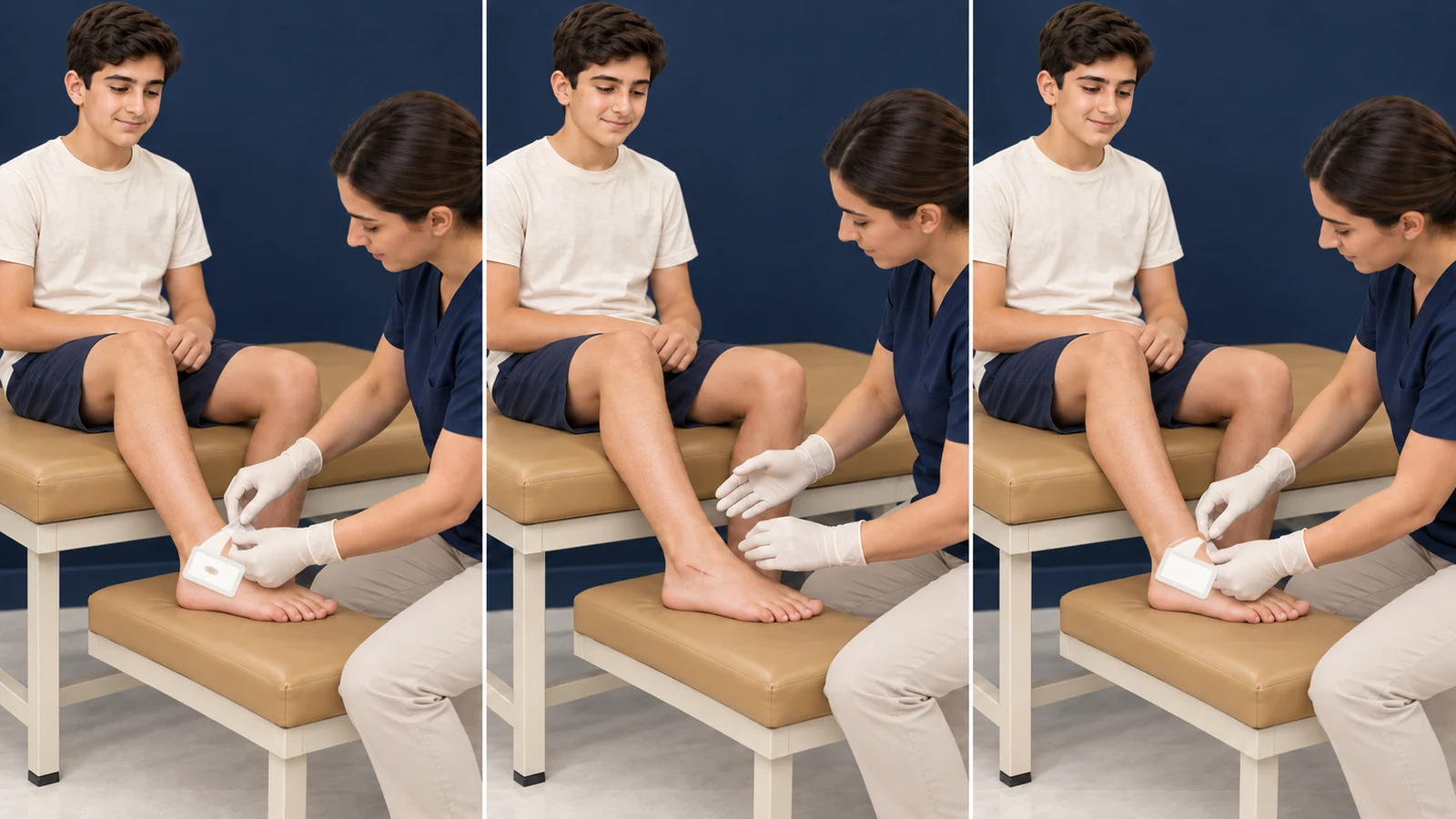
Do not remove the original dressing before the time set by the care team. If you have been taught to change it at home, follow the steps below. A trained carer should do this for a child and should not remove a cast or specialist dressing without instructions.
More detailLess detail
- Wash your hands and prepare a fresh dressing and the recommended supplies on a clean surface.
- Gently remove the outer covering. If it is stuck to the wound, do not pull it off; ask the care team for advice.
- Look at the wound without pressing on it or touching the wound line. A small stain that is decreasing is different from a dressing that keeps becoming soaked.
- Clean the wound only as you have been taught. Do not apply alcohol, povidone-iodine, ointments or home remedies without instructions.
- Do not touch the dressing pad or the wound surface. Apply a clean, dry covering without wrapping it tightly around the foot.
- If the dressing becomes wet, dirty or loose, contact the treatment centre to arrange an appropriate change; do not cover up a wet dressing by adding more layers.
- Do not pick off stitches, skin glue or wound closure strips. The time for their removal depends on how the wound was closed and how it is healing.
🚿 Keep the wound dry when washing
Until you know that showering is allowed and how to protect the dressing, wash your body in sections. Covering the foot with plastic alone does not guarantee that the dressing will stay dry.
More detailLess detail
- When showering, use a suitable protective cover and a stable seat, with a carer nearby.
- Keep the foot out of the direct stream of water and do not scrub the wound. Permission to shower does not mean you can wash the wound directly.
- If water gets inside the cover, ask for advice on changing the dressing. Do not remove a cast or walking boot for washing without instructions.
💊 Use the prescribed medicine dose
Give pain medicine according to the discharge sheet so that your child can rest and make necessary movements. A child's dose depends on weight, age and the strength of the product; do not use a prescription intended for an adult or another child.
More detailLess detail
- Write down the names and times of medicines, and use an oral syringe or medicine measure for liquid medicines.
- Check the labels of combination medicines so that the same pain medicine, especially paracetamol, is not given twice through different products.
- Do not start antibiotics, blood clot prevention medicine or supplements without instructions. Having an implant does not by itself mean that every patient needs these medicines.
- If a medicine makes you drowsy or dizzy, get help with walking and avoid activities that require balance.
🧊 Reduce swelling with rest and elevation
When sitting or lying down, rest your lower leg on a pillow to keep the foot raised without putting pressure on the wound. Leaving the foot hanging down for a long time or suddenly walking more can increase swelling and pain.
More detailLess detail
- Keep daily activities brief, with breaks between them to rest and raise your foot.
- If swelling or pain increases after an activity, do less the next time; do not push through pain to make progress.
- Use cold treatment only as recommended, with protection for the skin. Do not put ice directly on the skin or on a numb area, and keep the dressing dry.
- Avoid firm massage beside the implant or forcing the ankle and calf into a stretch during the first few days.
🚶 Three walking plans: why do instructions differ?
Different protocols follow three broad patterns. In the first, walking starts earlier with crutches and no cast. In the second, after 3 days, walking begins with a fixed walking boot and crutches for 25 days. In the third, a cast is used with no weight-bearing for 4 weeks, followed by the start of walking. The surgeon makes the final decision based on the severity of symptoms, the patient's age, associated findings and the details of surgery. The main instructions in this article cover only the pathway without a cast.
More detailLess detail
- On the pathway without a cast, weight-bearing as tolerated with two crutches starts on day 4 after surgery on one foot and day 7 after surgery on both feet. Do not put weight on the operated foot or feet before the specified start day.
- Weight-bearing as tolerated means putting only as much weight on the foot as allows you to walk comfortably and with control using crutches; you do not have to take your full body weight from the start.
- The crutches should be adjusted to your child's height before discharge. Start on a level surface with short steps and a carer supervising. If both feet have been operated on, the instruction to lead with the unaffected foot does not apply; learn how to move and use stairs in person.
- Crutches are usually stopped around 2 weeks after surgery, provided walking without them is safe and without a limp. If you still need to lean on the crutches or you are limping, keep using them and arrange an assessment.
- Having no cast does not mean you can run, jump or twist the foot suddenly. Increase walking distance gradually, without causing more pain or swelling.
🌱 A brief rehabilitation guide after Pro Stop
Judge progress by how well you walk, rather than by the number of days alone. These steps apply to the pathway without a cast; stretching and strengthening after a tendon procedure performed at the same time need a separate plan.
- Before weight-bearing starts: continue resting and caring for the wound, and move in the way you were taught. After surgery on both feet, use an appropriate aid, such as a wheelchair, for necessary journeys.
- Once weight-bearing starts: begin with two crutches, short steps and a level route. Increase the distance only if you are tolerating it well.
- As walking improves: if walking is still difficult after 2 weeks, arrange an assessment of pain, the implant site and the need for physiotherapy. Strength and balance work is planned according to the examination.
- Returning to sport: everyday walking should first be comfortable and free of a limp; then increase activity following the surgeon's assessment, without an increase in pain or swelling.
🚗 Returning to school and everyday activities
Returning to class is different from returning to PE. The right time depends on pain control, safe travel and the school's ability to accommodate the restrictions on your foot.
- 🎒 School: agree arrangements with the school for sitting, raising the foot, reducing long walks and temporary exemption from running and sport. There is no single return day that suits every child.
- 🪜 Stairs: use stairs only after practical instruction, with a handrail and help from a carer. After surgery on both feet, or while weight-bearing is not allowed, prioritise a route without stairs.
- 👟 Shoes: when swelling and the wound allow, wear roomy, supportive shoes that do not press on the operation site. Do not stop using prescribed footwear or a protective device earlier than instructed.
- 🏊 Swimming: on the pathway without a cast, swimming may be considered from around 1 month after surgery, provided the wound is fully closed and the surgeon approves. You must also be able to walk on wet surfaces and get into and out of the pool safely.
- ⚽ Sport: other sports are usually considered from around 3 months, depending on clinical progress. This does not guarantee readiness for football, jumping or competition; the type of sport, foot strength and balance also matter.
- 🚗 Driving: this guide is for children and adolescents. A teenager with a driving licence should not drive while unable to move the foot quickly and with control, while wearing a protective device or while taking sedating medicine; the time to return to driving needs a separate assessment.
- 🕌 Prayer: while sitting on your feet or getting up from the floor causes painful pressure, pray on a chair without loading the operated foot; ask your religious authority for guidance on the religious ruling.
❓ Common questions after Pro Stop flatfoot surgery
1) When can I start putting weight on my foot?
On the pathway without a cast, weight-bearing as tolerated with two crutches starts on day 4 after surgery on one foot and day 7 after surgery on both feet. These times apply to this pathway; do not use them to replace a prescribed plan involving a cast, walking boot or additional procedure.
2) Does having no cast mean I do not need crutches?
No. On the pathway described here, walking starts with two crutches. You rely on them less as your foot tolerates more weight and your steps improve; having no cast does not mean you can walk without help from the day of surgery.
3) Does weight-bearing as tolerated mean putting all my weight on the foot?
No. At first, put only as much weight on the foot as lets you take comfortable, safe steps with crutches. If walking means pushing through pain or limping, the load and distance are still too much.
4) How do I get around if both feet were operated on at the same time?
Practise how to move before leaving hospital. Before weight-bearing starts, you may need a wheelchair and help from a carer; once it starts, use two crutches as you were taught. Do not improvise a way of using stairs or getting around by hopping on one foot.
5) When should I change the dressing?
Change it for the first time at the time set by the care team. If you have not been taught to change it at home, do not remove it; report a dressing that is wet, dirty or loose so that you can get advice.
6) When can I shower?
You can shower once you know how to protect the wound and have been given permission to shower. Until then, washing your body in sections is a suitable option. Permission to shower does not mean you can wash the wound directly or get a cast wet.
7) Should I be worried about swelling after surgery?
Some swelling may occur after surgery and may increase when the foot hangs down. Overall, it should be improving; new or worsening swelling, or swelling with any of the signs in the warning section, needs assessment.
8) Should I put up with pain on the outside of my foot until it gets used to the implant?
Do not assume that persistent or increasing pain is simply the foot getting used to the implant. The outer side of the foot is close to the implant site, and an examination may be needed to assess the wound, surrounding tissues or implant position. Pain does not always mean the implant needs to be removed.
9) When are stitches removed?
This depends on the type of stitch and how the wound is healing. Some stitches dissolve and others need to be removed. Follow the date recorded on your discharge sheet or given at your appointment, and do not remove stitches or wound adhesive yourself.
10) Will I definitely need insoles after surgery?
Not every patient needs insoles in the same way. The surgeon decides based on the examination, footwear and any remaining symptoms. Buying insoles or corrective shoes does not replace follow-up for pain and assessment of walking.
11) Does everyone need physiotherapy?
No; the need for physiotherapy varies from person to person. If a limp, weakness, stiffness or difficulty walking persists, assessment and an individual plan can help. Do not immediately add general flatfoot exercises to the care of a newly operated foot.
12) Will the implant definitely have to be removed later?
There is no single timing or decision for everyone. The type of implant, the child's growth, symptoms and the surgeon's judgement determine this. Planned removal in some studies does not mean that every patient needs removal at the same time.
13) Does the same plan apply if the Achilles tendon or a calf muscle was also operated on?
No; do not automatically follow the no-cast plan in this article. Protecting the tendon or muscle may change the protective device needed, when weight-bearing starts and calf stretching. The instructions for the additional procedure should be clearly recorded on the discharge sheet.
14) Do I need follow-up appointments and X-rays?
Keep attending follow-up appointments even if pain improves. The surgeon assesses the wound, how you walk and the implant site, and requests X-rays if needed. An X-ray that looks satisfactory does not by itself show that the foot is ready for sport.
15) Does returning to school mean I can also take part in PE?
No. You may be able to sit in class and get around with help while the foot is still not ready for running, jumping or team games. Agree the sports restrictions with the school separately.
✅ Summary
After Pro Stop, wound care and a gradual return to walking matter. The main instructions in this article cover the pathway without a cast; the surgeon chooses between this approach, a walking boot and a cast. To guide progress, consider the quality of your steps and how your foot responds to activity, and do not treat dates on a calendar as a guarantee of readiness for sport.
For an assessment of walking, pain on the side of the foot or a plan for returning to sport, call Dr Jalil Emad’s clinic on 0913 782 5207, or book an appointment online. In an emergency, do not wait for the clinic to reply; follow the instructions in the warning signs section.
See the related services on this page: Paediatric orthopaedics and congenital conditions
This content is for general education only and does not replace an examination, advice from the treating doctor, your discharge sheet or your surgeon's individual protocol. Timing, range of movement, weight-bearing and the amount of exercise vary with the operation, any additional procedures and each person's circumstances. Do not change medicines, dressings or your exercise plan without discussing it with the care team.
📚 Scientific sources
View the sources and guidance used
- De Salvatore S, et al. Return to Sport After Subtalar Arthroereisis in Pediatric Flexible Flatfoot: Radiographic Correction and Residual Pain Are Not Independent Predictors. Children. 2026;13(5):632. doi:10.3390/children13050632. https://pmc.ncbi.nlm.nih.gov/articles/PMC13204168/
- Alkhatatba et al. Subtalar Arthroereisis for Symptomatic Flexible Flatfoot in Adolescents: A Prospective Study of 26 Feet. Mater Sociomed. 2024;36:131–136. doi:10.5455/msm.2024.36.131-136. https://pmc.ncbi.nlm.nih.gov/articles/PMC11663004/
- Silva et al. Calcaneo-stop for paediatric idiopathic flexible flatfoot: High functional results and return to sport in 644 feet at mid-term follow-up. J Exp Orthop. 2025;12:e70182. doi:10.1002/jeo2.70182. https://pmc.ncbi.nlm.nih.gov/articles/PMC11840700/
- Mazzotti A, et al. Subtalar arthroereisis post-operative management in children: A literature review. Foot. 2023;56:102037. doi:10.1016/j.foot.2023.102037. https://pubmed.ncbi.nlm.nih.gov/37167704/
- Langstroth M, et al. Use of the Arthrex ProStop Subtalar Arthroeresis Screw in the Management of Symptomatic Paediatric Flexible Flatfoot. Cureus. 2024;16:e72151. doi:10.7759/cureus.72151. https://pmc.ncbi.nlm.nih.gov/articles/PMC11581446/
- Arthrex. ProStop Implant: surgical technique, LB1-0431-EN_H. https://cdn.arthrex.io/image/upload/45d69dd8-1a44-4d16-b025-b54f0eacf782.pdf
- NICE. Surgical site infections: prevention and treatment (NG125), postoperative phase. https://www.nice.org.uk/guidance/ng125/chapter/Recommendations
- Royal National Orthopaedic Hospital. A Patient’s guide to Preparing for foot and ankle surgery. https://www.rnoh.nhs.uk/patients-and-visitors/patient-information-guides/preparing-foot-and-ankle-surgery
- Great Ormond Street Hospital. Pain relief for your child after surgery. https://www.gosh.nhs.uk/conditions-and-treatments/procedures-and-treatments/pain-relief-for-your-child-after-surgery/
- American Academy of Orthopaedic Surgeons. Care of Casts and Splints. https://www.orthoinfo.org/recovery/care-of-casts-and-splints/
- NHS. Deep vein thrombosis (DVT). https://www.nhs.uk/conditions/deep-vein-thrombosis-dvt/
- UK FCDO. Iran travel advice: Getting help, emergency services. https://www.gov.uk/foreign-travel-advice/iran/getting-help
- Great Ormond Street Hospital. How to care for a wound after surgery. https://www.gosh.nhs.uk/conditions-and-treatments/procedures-and-treatments/how-to-care-for-a-wound-after-surgery/
- Alder Hey Children’s NHS Foundation Trust. Use of Crutches, PIAG 527. https://www.alderhey.nhs.uk/wp-content/uploads/2024/03/PIAG-527-Use-of-Crutches.pdf
- Gloucestershire Hospitals NHS Foundation Trust. Weight bearing with Crutches and Zimmers / Walking Frame. https://www.gloshospitals.nhs.uk/our-services/services-we-offer/trauma-orthopaedics/plaster-room/weight-bearing-with-crutches-and-zimmerswalking-frame/
- NHS. Pulmonary embolism. https://www.nhs.uk/conditions/pulmonary-embolism/
- NHS. Ibuprofen for children: formulation and dose information. https://www.nhs.uk/medicines/ibuprofen-for-children/
- Royal National Orthopaedic Hospital. Instructions for Children in a Leg Cast. https://www.rnoh.nhs.uk/patients-and-visitors/patient-information-guides/instructions-children-leg-cast
Dr. Jalil Emad
Orthopedic specialist and surgeon, board-certified in bone and joint surgery; years of experience in knee and hip replacement, sports injuries and arthroscopy in Isfahan.