
On this page
- 🦴 What is knee osteoarthritis, and why is surgery considered?
- ⏳ What happens if you do not have the operation?
- 🏋️ Preparing before surgery
- 🏥 The day before surgery and the day itself
- ⚕️ How is the operation performed?
- 🗓️ After surgery at a glance
- 🎯 Returning to daily life — answers to your 20 questions
- ✅ Summary and your next step
- 📚 Scientific sources
Total Knee Replacement: The Pre-Operative Guide
What to know before knee replacement: what knee osteoarthritis is, what happens if you do not operate, how to prepare, what takes place in the operating room, and answers to 20 questions about returning to daily life.
21 min read

Your surgeon has told you that your knee is a candidate for joint replacement, and now you have dozens of questions: is it really necessary? What happens if I do not have it done? What takes place in the operating room, and when will I get back to normal life? This guide follows that whole path, from the first question to your return to daily life. What you are reading describes the common scenario of a primary total knee replacement; your own decision and specific details are settled after examination and review of your imaging, and your care team's written instructions always take precedence.
🦴 What is knee osteoarthritis, and why is surgery considered?
The bone surfaces inside your knee are covered by a layer of cartilage — a smooth, slippery, shock-absorbing surface that lets the knee bend and straighten without pain. In osteoarthritis this layer gradually becomes thin and uneven. Once cartilage is completely lost in an area, bone works against bone, the body builds bony spurs at the joint margins, and the joint space narrows.
The pattern of complaints is usually familiar: pain that worsens with walking, stairs and prolonged standing and eases with rest, brief morning stiffness, intermittent swelling, a coarse grating sound on bending, and gradual bowing of the leg. Most patients who undergo knee replacement are between 50 and 80 years old, although there is no absolute age or weight limit for this operation.
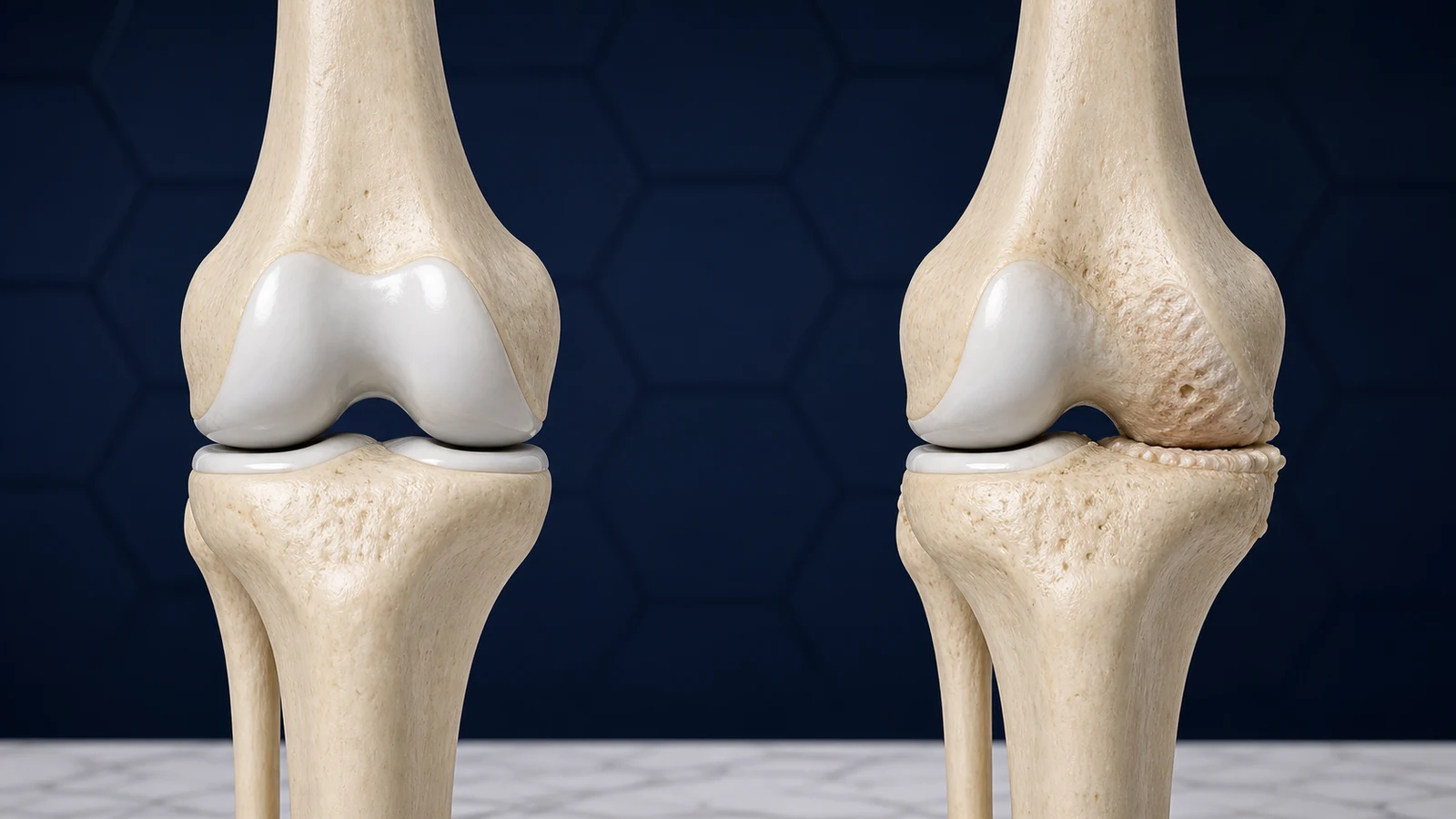
Surgery is not the first option. Clinical guidance treats therapeutic exercise as the core treatment of osteoarthritis for every patient, alongside weight management, appropriate pain relief and, in selected cases, injections. These often work: in the long-term follow-up of one randomised trial, about 80% of patients managed non-operatively had still not needed a joint replacement 10 years later.
So surgery comes into the picture when pain and limitation persist despite non-surgical treatment, disrupt your sleep, walking or daily tasks, and imaging also shows advanced joint damage. Importantly, clinical guidance states explicitly that age, sex, smoking, comorbidities or excess weight should not on their own exclude someone from referral for joint replacement; the assessment is made case by case with the surgeon. If the damage is confined to one compartment of the knee, partial knee replacement is also a valid option, examined through your examination and X-rays.
⏳ What happens if you do not have the operation?
First, the most honest point: knee replacement is an elective operation, not an emergency. Knee osteoarthritis does not threaten your life, and if non-surgical treatment gives you an acceptable quality of life, waiting is a reasonable decision. The main criterion for this operation is your quality of life, not the appearance of your X-ray alone.
But endless postponement is not free either, and the cost is more functional than life-threatening:
- Your final result depends on your starting point. In research, patients who came to surgery with far lower function and capacity did not reach the functional level after surgery of patients operated on earlier; this difference was even more striking in the knee than in the hip.
- Muscle weakness accumulates. Pain leads to inactivity, inactivity wastes the quadriceps, and that same muscle is the engine of your rehabilitation after surgery.
- The load shifts elsewhere. Prolonged limping draws in the other knee, the hip and the lower back, and inactivity can worsen weight, blood sugar and blood pressure.
- Progressive deformity makes the operation more technically demanding. Severe bowing of the leg and loss of bone stock make correction harder.
A fair summary: you neither need to operate at the first diagnosis of osteoarthritis, nor is it better to wait until you are completely disabled. The right point is where pain and limitation, despite serious non-surgical treatment, are what dictate your daily life.
🏋️ Preparing before surgery
For knee replacement, preparing beforehand is not merely optimistic advice. In a meta-analysis of randomised trials, exercise before surgery improved knee function and strength before the operation with moderate-certainty evidence, and also improved function at six weeks after it. Another review shows this advantage is visible up to about 3 months after surgery, with uncertain long-term effect. In other words, preparation moves the start of your rehabilitation forward.
General preparation of your body
- Stop smoking; this is one of the lowest-cost things you can do for wound healing and for reducing complications.
- Get your blood sugar, blood pressure and anaemia managed with your physician before surgery.
- Treat an infected tooth or gum before surgery; a source of infection far from the knee can still put an artificial joint at risk.
- The skin around the knee must be healthy. Show your surgeon any wound, infected spot, graze or fungal infection before the operation.
- If you are overweight, losing weight helps — but do not treat it as a reason to postpone referral.
Preparation exercises
In trials, preparation programmes usually ran for several weeks before surgery, 2 to 3 sessions a week, focusing on quadriceps strength and maintaining range of motion. These two are the most basic; your own programme is set by your physiotherapist.
Quadriceps Set
You tighten the muscle at the front of the thigh without moving the knee. It is the same muscle that will have to hold your knee straight after surgery, and training it beforehand raises the starting point of your rehabilitation.
More detailLess detail
Starting position: Lie on your back or sit with the leg stretched out in front of you; place a thin towel under your ankle.
How to do it:
- Tighten the muscle at the front of the thigh so that the back of the knee presses down towards the bed.
- Hold the contraction for a few seconds and feel the kneecap draw slightly upwards.
- Release slowly and rest for a few seconds.
Range and limits: The knee does not move; this is muscle contraction only.
Breathing: Calm and continuous; do not hold your breath.
Stop immediately if: you feel sharp knee pain, new swelling, or a painful thigh cramp.
Common mistake: Lifting the whole leg instead of contracting the muscle.
Heel Slide
You draw the heel along the bed towards your buttock so the knee bends as far as is comfortable. The aim is to preserve range of motion, because your range before surgery is one of the factors that shapes your range afterwards.
More detailLess detail
Starting position: On your back on the bed, both legs straight.
How to do it:
- Slide the heel gently along the bed towards your buttock so the knee bends.
- Hold for a few seconds at the end of the comfortable range.
- Slide the heel slowly back to the start so the knee straightens fully.
Range and limits: To a gentle stretch, not to pain; do not force it, and do not let anyone push the knee.
Stop immediately if: you feel sharp pain, the knee locks, or swelling increases after the exercise.
Common mistake: Leaving the knee half-bent and not straightening it fully at the end of each repetition.
Getting your home ready
- Obtain a walker or a pair of crutches in advance and practise walking with them.
- Clear away slippery rugs and cables across your path; the route from bed to bathroom must be flat and well lit.
- If your bedroom is upstairs, arrange somewhere to sleep on the ground floor for the first weeks.
- Prepare a firm chair with armrests at a suitable height, and a shower stool; a very low chair makes standing up difficult.
- Prepare a few days of meals in advance and move everyday items to shelves at hand height.
🏥 The day before surgery and the day itself
The day before
- Fasting: Exactly as your anaesthesia team instructs. Get the starting time from them and do not decide it from other people's experience.
- Medicines: Bring a complete list of the medicines, supplements and herbal products you take. Daily medicines — especially blood thinners and diabetes medicines — must be coordinated in advance with your surgeon and the anaesthesia team; never stop or add any medicine on your own.
- Washing: Shower the night before or on the morning of surgery as the hospital instructs. Do not shave the operative area with a razor at home; small grazes can be an entry point for infection.
- Bring with you: identity and insurance documents, recent X-rays and tests, your medicine list, your walker or crutches, loose comfortable clothing, and closed, non-slip shoes with a low heel.
- Remove nail polish and jewellery, and arrange a companion for the day of surgery and the first days at home.
On the day
The sequence is similar in most centres: admission and changing into a theatre gown, checking vital signs and inserting an intravenous line, meeting the anaesthetist and signing the consent form, and marking of the correct leg by the surgeon. That marking is a standard safety step; if it has not been done, remind the team yourself. You are then taken to the operating room. Your family waits in the waiting area throughout, and the surgeon informs them of the outcome once the operation is finished.
⚕️ How is the operation performed?
Anaesthesia
This operation is performed both under spinal anaesthesia and under general anaesthesia, and the choice between them depends on your own situation: comorbidities, medicines, the state of your spine and your own preference. The final decision is made with you by the anaesthetist at the pre-operative visit. Under spinal anaesthesia you are awake but the lower body is numb, and you usually also receive a sedative.
What happens in the operating room
The operation usually takes 1 to 2 hours. The surgeon makes an incision at the front of the knee and exposes the joint. A thin layer of the worn surface at the end of the thigh bone and the top of the shin bone is then removed — just enough for the artificial components to sit in its place. A metal component is placed on the thigh bone and a metal plate on the shin bone, and between the two sits a durable polyethylene insert that plays the part of the smooth cartilage surface.

The kneecap is a selective decision: if the cartilage behind it is healthy or reasonably healthy it is preserved, and if its damage is significant its surface is also replaced with a polyethylene component. This decision is made during the operation itself, on seeing the real state of the joint.
The components are usually fixed with bone cement. At the end, the surgeon checks ligament balance and the alignment of the leg, tests the knee through its range of motion, closes the layers and applies a dressing. You are then moved to recovery and stay under observation there until your consciousness and vital signs are stable.
🗓️ After surgery at a glance
Most patients stay in hospital for 1 to 2 nights. Contrary to a common assumption, you are not going to spend weeks in bed: with your care team's approval, standing and taking a few steps with a walker usually begins on the day of surgery itself or the following morning, and physiotherapy starts in the first days.
The broad outline of the first weeks is this: pain control with your discharge prescription, cold and elevation for swelling, an anticoagulant and frequent movement to prevent clots, and wound review with removal of stitches or staples usually about 10 to 14 days after surgery. Daily exercise to achieve full straightening and gradual bending of the knee is the most important work you yourself do in this period.
Full details of wound care, the step-by-step exercise programme, warning signs and a safe return to activity are in a separate guide: the complete guide to care and rehabilitation after total knee replacement.
🎯 Returning to daily life — answers to your 20 questions
These are the questions patients usually ask before deciding on surgery. The times are common ranges, not rules; your own care team's instructions take precedence.
1) How much pain will I have after surgery, and for how long?
The first days are the most painful part of the journey and are managed with your discharge prescription, cold and elevation. The decline in pain is usually noticeable from the second week onwards, but swelling and discomfort with heavy activity can continue for several months. Pain that does not settle at all with the prescribed painkiller is not normal and should be reported.
2) How many nights will I be in hospital?
In most cases 1 to 2 nights. The exact length depends on pain control, your ability to walk with a walker, your general condition and your circumstances at home. Discharge happens once you can move about with a walking aid and know your medicine and exercise plan.
3) When can I put weight on the operated leg?
In a primary, uncomplicated replacement you usually bear weight as tolerated with a walker from the day of surgery or the day after. This is one of the important differences between joint replacement and many other operations. If your discharge sheet specifies a weight-bearing restriction, that takes precedence.
4) How long will I need a walker and a cane?
Most patients start the first weeks with a walker, then move to a cane and then to walking independently. The criterion for giving up the aid is not a date: you should walk without limping, without fear of falling and with confident balance. Abandoning the aid too early makes a limp into a habit.
5) When are the stitches or staples removed?
Usually about 10 to 14 days after surgery, at the same wound-review visit. If absorbable subcuticular sutures were used there is nothing to remove and the wound is simply inspected. Until then, follow the dressing and showering instructions on your discharge sheet.
6) When does physiotherapy start, and how long does it last?
From the first days in hospital. A structured programme usually continues for several weeks to several months, and most of it consists of exercises you do yourself at home every day. Progress is measured by criteria — range of motion, strength and quality of walking — not by the number of sessions.
7) When can I drive?
The usual advice is about 4 to 6 weeks after surgery. In a meta-analysis measuring brake reaction time, that time returned to its pre-operative level about 4 weeks after a right-sided knee replacement. The conditions matter more than the date: you must have finished opioid painkillers, be able to control the pedal without pain and perform an emergency stop. For a left knee in an automatic car it is usually possible sooner.
8) When can I start desk-based, seated work?
Seated work is often possible earlier than physical work, and many patients return part-time or remotely in the first weeks. The practical conditions are pain controlled without opioid painkillers, and being able to elevate the leg and get up every hour. Sitting for long periods without moving is bad both for swelling and for clot risk.
9) What about standing or heavy work?
In a systematic review of the research, the average time to return to work after knee replacement was reported as about 8 to 12 weeks, with manual and demanding jobs at the far end of that range or later. Repeated ladder climbing, repeated squatting and standing, and lifting heavy loads should be resumed gradually and with your surgeon's approval.
10) How should I manage stairs?
The simple rule is: going up, the good leg first; coming down, the operated leg and the cane first. Keep one hand on the handrail at all times, and if someone is with you they should stand one step below you when you come down. In the first weeks take the stairs one at a time and without hurrying.
11) How should I sleep?
Sleeping on your back with the operated leg straight is a safe position. Do not put a pillow under the knee, because sleeping for long periods with the knee bent delays full straightening; if the leg needs elevating, put the pillow under the calf and heel. Sleeping on your side with a pillow between the knees usually becomes possible after a few weeks, once the knee is more comfortable.
12) When can I shower?
This depends on your type of dressing and must be read from your discharge sheet: with an intact waterproof dressing it is often sooner, and with an ordinary dressing usually some days later. Until the wound is fully closed, baths, swimming pools and public baths are off limits. A shower stool and a non-slip mat genuinely reduce the risk of falling.
13) How should I pray?
In the first weeks, praying seated on a chair, or standing with prostration onto a raised turbah, is an accepted solution that puts no strain on the knee. Kneeling and repeatedly rising from the floor are precisely the movements that place the greatest load on a newly operated knee. A return to your usual form should be gradual and follow your care team's approval.
14) When is sexual activity possible again?
Usually after a few weeks, once pain is controlled and the wound has closed, choosing positions that do not put weight or twist through the operated knee. The operated knee should not be placed in deep flexion under load. If you have a specific question, raising it with your care team is entirely routine.
15) When can I travel or fly?
Short journeys with regular stops to walk become possible sooner. For flying, particularly long flights, coordinate with your surgeon before booking; prolonged immobility raises clot risk and you may have specific advice. During the journey move your ankles regularly and get up every hour or two.
16) Which sports are suitable after knee replacement?
Unlimited walking, swimming, a stationary bicycle, golf, light hiking and gentle dancing are among the low-impact activities that are recommended. These are good both for the knee and for your weight and heart health. Any sport should be started gradually and with your care team's approval.
17) What about running, football and high-impact sports?
Most surgeons advise against high-impact activities such as running, jumping and contact sports after knee replacement, because repeated impact loading increases wear of the polyethylene insert and the long-term risk of the components loosening. If a particular sport matters to you, discuss it with your surgeon before surgery so that your expectations are realistic.
18) Can I kneel or sit on the floor?
Kneeling on an artificial joint is usually uncomfortable, but it does not damage the implant. Many patients do it rarely or not at all, and that choice causes no problem. For sitting on the floor and using a squat toilet, use a chair and a Western toilet or a toilet chair in the first weeks; any return should be gradual, on a soft surface and with your care team's approval.
19) How far will the artificial knee bend?
The realistic goal is a range that makes daily tasks possible: walking, sitting on a chair, going up and down stairs and getting into a car. Full straightening of the knee matters as much as bending it, and is often harder to achieve. Your range before surgery is one of the factors that shapes the final range — which is exactly what makes the preparation exercises worthwhile.
20) How many years does an artificial joint last?
In an analysis of national registry data, about 82% of total knee replacements were still in place at 25 years, and more than 90% of modern implants were functioning well 15 years after surgery. Younger age at surgery, higher weight and high-impact activities all increase the likelihood of needing further surgery. Periodic follow-up, even when nothing is wrong, is part of preserving that durability.
✅ Summary and your next step
Total knee replacement is an elective decision whose purpose is to reduce pain and return you to daily life, not to build the knee of a twenty-year-old. Its right moment is where pain and limitation, despite serious non-surgical treatment, dictate your life — not earlier, at the first diagnosis, and not so late that you come to surgery already disabled and weakened. Preparing beforehand, from quadriceps strengthening to getting your home ready, shortens your road back.
To learn more about this area of care, see the Joint Replacement & Reconstruction page.
To have your own knee assessed, contact Dr. Jalil Emad's office or book an appointment online.
۰۹۱۳۷۸۲۵۲۰۷ Book an appointmentThis content is provided for general education only and does not replace examination and the opinion of your treating physician. The final decision about whether and how to operate is made after examination, review of imaging and consideration of each patient's specific circumstances. Change medicines and pre-operative preparation only in coordination with your surgical and anaesthesia team.
📚 Scientific sources
View scientific sources
- NICE guideline NG226: Osteoarthritis in over 16s — diagnosis and management — nice.org.uk
- AAOS OrthoInfo: Total Knee Replacement — orthoinfo.org
- Evans JT, et al. How long does a knee replacement last? Lancet 2019;393:655–663 — doi.org
- Punnoose A, et al. Prehabilitation for Patients Undergoing Orthopedic Surgery. JAMA Netw Open 2023;6(4):e238050 — doi.org
- Gränicher P, et al. Prehabilitation Improves Knee Functioning Before and Within the First Year After TKA. J Orthop Sports Phys Ther 2022;52(11):709–725 — doi.org
- Fortin PR, et al. Preoperative functional status predicts outcomes at six months after surgery. Arthritis Rheum 1999;42(8):1722–1728 — pubmed.ncbi.nlm.nih.gov
- van der Velden CA, et al. When is it safe to resume driving after THA and TKA? Bone Joint J 2017;99-B:566–576 — doi.org
- Tilbury C, et al. Return to work after total hip and knee arthroplasty: a systematic review. Rheumatology 2014;53(3):512–525 — doi.org
- Wilson HA, et al. Patient relevant outcomes of unicompartmental versus total knee replacement. BMJ 2019;364:l352 — doi.org
- Birmingham TB, et al. Incidence of Total Knee Arthroplasty After Arthroscopic Surgery for Knee Osteoarthritis. JAMA Netw Open 2024;7(4):e246578 — doi.org

Dr. Jalil Emad
Orthopedic specialist and surgeon, board-certified in bone and joint surgery; years of experience in knee and hip replacement, sports injuries and arthroscopy in Isfahan.
Related articles
ACL Reconstruction Surgery: Postoperative Care and Rehabilitation
An evidence-informed, criteria-based guide to surgery day and care after ACL reconstruction—from wound care, medicines and warning signs to the first 90 days of rehabilitation and a safer return to driving, work and sport.

Total Knee Replacement Surgery: Postoperative Care and Rehabilitation
A complete, criteria-based guide to surgery day and care after total knee replacement—from wound care, medicines, and warning signs to the first 90 days of rehabilitation and a safer return to activity.
Carpal Tunnel Release Surgery: Wound Care and Finger Movement
A short, evidence-based guide to the first days after carpal tunnel release—from the dressing, showering and warning signs to finger movement, returning to work and common questions.