On this page
- 🦴 What is recurrent shoulder dislocation, and why is surgery considered?
- ⏳ What happens if you do not have the operation?
- 🏋️ Preparing before surgery
- 🏥 The day before surgery and the day itself
- ⚕️ How is the operation performed?
- 🗓️ After surgery at a glance
- 🎯 Returning to everyday life — answers to your 20 questions
- ✅ Summary and next step
- 📚 Scientific sources
Recurrent Shoulder Dislocation: The Pre-Operative Guide to Latarjet and Arthroscopic Labral Repair
What to know before shoulder stabilisation surgery: why the shoulder keeps dislocating, what happens to the socket rim and cartilage if you do not operate, what arthroscopic labral repair and the Latarjet procedure each do, and answers to 20 questions about returning to daily life and sport.
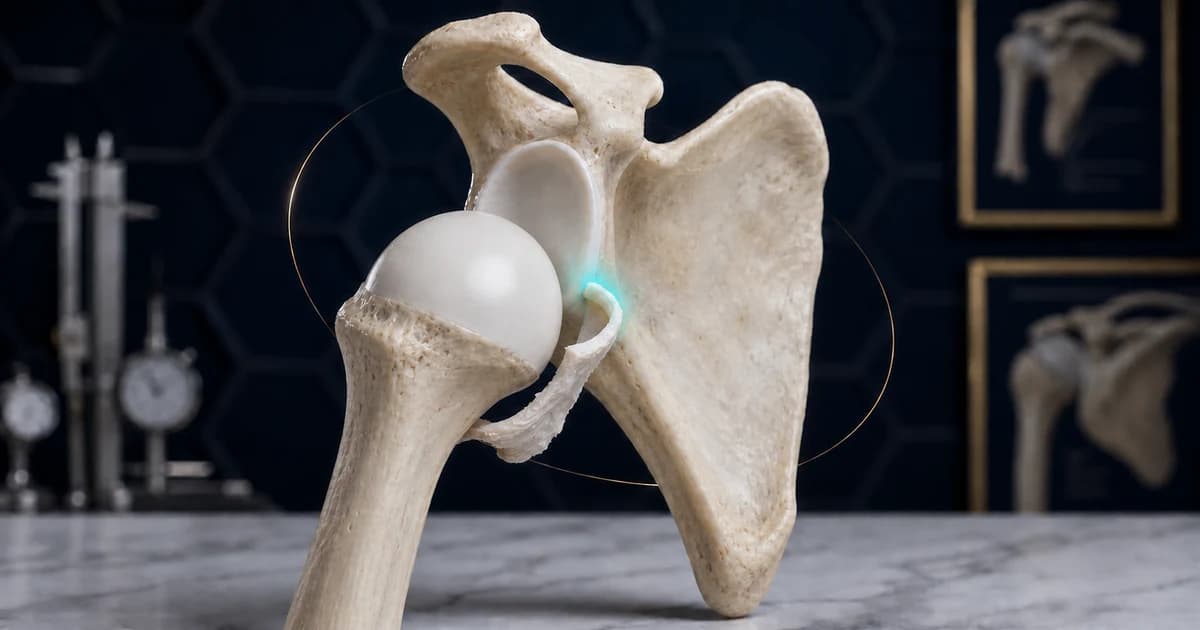
A shoulder that dislocates once and then again and again is no longer an accident; it is a sign that something inside the joint has torn and will not put itself back. If your surgeon has told you that your shoulder is a candidate for stabilisation surgery, you have probably heard two names: “arthroscopic labral repair” and “the Latarjet procedure”. This guide explains what has happened inside the shoulder, what lies ahead if you do not operate, and what each of these two operations actually does. What you are reading is the common scenario of anterior shoulder instability in an adult; the choice of procedure is made after examination and imaging, and your treating team’s written instructions always take precedence.
🦴 What is recurrent shoulder dislocation, and why is surgery considered?
The shoulder is the most mobile joint in the body and pays for it with limited stability. The round head of the arm bone sits on a shallow socket on the shoulder blade — more like a golf ball on a tee than a ball in a cup. What holds that ball in place is the labrum: a ring of tough cartilage that grips the rim of the socket, deepens it, and to which the ligaments at the front of the joint are attached.
In an anterior dislocation the head of the arm bone jumps forward, and at that moment the labrum and ligament are stripped off the front rim of the socket; this tear is called a Bankart lesion. Sometimes a fragment of the bony rim itself breaks off as well. At the same time the back of the humeral head strikes the hard rim and is left with a dent, known as a Hill-Sachs lesion.

The core problem is that the detached labrum usually does not heal back in the right place; it heals looser, and the front of the socket stays “open”. That is why the second dislocation happens more easily than the first, and the third more easily than the second. About 80 per cent of anterior-inferior dislocations occur in young people, and in that group recurrence is the rule, not the exception. The complaint is familiar: repeated dislocations or partial dislocations, a sense of the shoulder giving way, and above all the fear of one particular position — when the arm goes up and back, as in throwing a ball.
Surgery is not the first option. After a first dislocation, a short period in a sling followed by regular physiotherapy is a reasonable path and is enough for some patients; it simply takes several months before you can judge the result. But physiotherapy cannot reattach a detached labrum to bone, and it cannot rebuild a worn-away rim. When the shoulder keeps dislocating despite proper rehabilitation, surgery closes the remaining gap.
⏳ What happens if you do not have the operation?
First, the most honest point: this is not an emergency operation. If dislocations are rare, occur only in very specific positions, and do not dictate your life or your work, waiting is a defensible decision. The main criterion is how much you are genuinely limited.
But indefinite delay is not free, and the direction of travel is clear:
- Every dislocation wears the rim of the socket. Bone at the front of the socket is gradually lost, the socket becomes shallower, and the next dislocation happens with less force — a cycle that feeds itself.
- The dent in the humeral head deepens. In studies, a greater number of dislocations has been associated with more severe joint lesions.
- The joint cartilage suffers. In long-term follow-up of patients treated non-operatively, roughly two thirds showed evidence of shoulder arthritis at 25 years.
- Surgical options narrow. Once more bone has been lost, a simple soft-tissue repair is no longer enough and an operation that adds bone becomes necessary; delay makes the next operation bigger.
- Life gets smaller. Many patients, without ever saying so, give up sport, reaching overhead, and even certain sleeping positions so that the shoulder will not go out.
A fair summary: you need not operate at the first dislocation, nor is it better to wait until the joint wears out. The right point is where recurrent dislocation — or the fear of it — is dictating your everyday choices, and you have already given proper rehabilitation a fair trial.
🏋️ Preparing before surgery
For these two operations there is no dedicated, high-quality trial showing that exercise before surgery improves the final result, and it is more honest to say so. What we do know about the shoulder is that a stiffer shoulder before surgery regains its range of motion more slowly afterwards. So the aim of preparation here is not strength; it is to walk into the operating room with a supple, pain-free shoulder.
General body preparation
- Stop smoking; it is the cheapest thing you can do for wound healing and for reducing the risk of infection.
- Have your blood sugar, blood pressure and anaemia optimised with your doctor before surgery.
- The skin of the shoulder and armpit must be healthy. Show your surgeon any boil, fungal infection or scratch before the operation, and do not shave the area at home with a razor.
- Daily medicines — especially blood thinners and diabetes medicines — must be coordinated in advance with your surgeon and the anaesthesia team; never stop or add any medicine on your own.
Preparing your home for the sling period
- For the first few weeks you will effectively have one hand. Get loose, front-opening shirts; dress the operated side first, and when undressing take the healthy side out first.
- Prepare where you will sleep: extra pillows for sleeping semi-upright, and a rolled towel to place under the elbow.
- Put frequently used items within reach of your good hand, and arrange a companion for the day of surgery and the first days at home.
Preparation exercises — for range of motion only
Neither of these two exercises is a strengthening exercise, and neither takes the shoulder into the danger position. In anterior instability the danger position is specific: the arm moving away from the body while rotating outwards — the throwing position. Do not take any exercise in that direction, and never force a stretch. Your individual programme is set by your surgeon or physiotherapist.
Pendulum
You bend the trunk slightly forward, let the arm hang free, and let it circle with the movement of your body. The shoulder does no work at all; it simply keeps the joint capsule supple. Stop immediately if: you feel the shoulder slipping, sharp pain, or numbness or tingling in the hand.
More detailLess detail
Starting position: Stand beside a table, rest your good hand on it, and bend forward slightly from the waist so the affected arm hangs free.
How to do it:
- Let the shoulder muscles go completely; the arm should hang like a rope.
- Using slow movement of your trunk and hips, swing the arm in small circles.
- Do a few circles in each direction and come gently to a stop.
Range, side, and limits: Keep the circles small, and do not let the hand rise above horizontal.
Stop immediately if: you feel the shoulder slipping, sharp pain, or numbness or tingling in the hand.
Common mistake: Swinging the arm with the shoulder muscles instead of relaxing it and moving the trunk.
Table slide
You slide the hand forward along a table so the shoulder lifts. Because the table carries the weight of the arm, elevation is maintained without loading the joint. Stop immediately if: you feel instability, sharp pain at the front of the shoulder, or a click with pain.
More detailLess detail
Starting position: Sit at a table and rest the forearm of the affected side on a smooth cloth on the table top.
How to do it:
- Keep your trunk upright and slide the hand slowly forward along the table.
- Wherever you feel a gentle stretch, hold for a few seconds.
- Slide the hand slowly back to the starting position.
Range, side, and limits: The hand travels straight in front of the body and does not drift outwards; go to a gentle stretch, never to pain.
Stop immediately if: you feel instability, sharp pain at the front of the shoulder, or a click with pain.
Common mistake: Letting the hand drift out to the side, which is movement towards the danger position.
🏥 The day before surgery and the day itself
The day before
- Fasting: exactly as the anaesthesia team instructs; get the starting time from them and do not decide from other people’s experience.
- Medicines: bring your complete medication list; any change or interruption only after prior coordination with your surgeon and the anaesthesia team.
- Washing: shower the night before or on the morning of surgery as the hospital instructs. Do not shave the armpit or shoulder with a razor; tiny cuts can become entry points for infection.
- Bring with you: identity and insurance documents, recent shoulder imaging, your medication list, the sling if you have already been given one, and a loose front-opening shirt you can put on with one hand.
- Remove nail polish, rings and watches, and arrange a companion for the day of surgery and the first days at home.
The day of surgery
The sequence is similar in most centres: admission, checking vital signs and inserting a cannula, meeting the anaesthetist and signing consent, and the surgeon marking the correct arm. That marking is a standard safety step; if it is not done, remind them yourself. A nerve block is usually given before you are taken to the operating room. Shoulder stabilisation is a day-case procedure in many centres and patients go home the same day; after open surgery an overnight stay is more likely.
⚕️ How is the operation performed?
Anaesthesia
Both operations are usually performed under general anaesthesia, often with an interscalene nerve block added: under ultrasound guidance, the nerves running from the neck to the shoulder are numbed so that they take away the pain of the first hours. The block lasts about a day. The final choice belongs to the anaesthetist.
Choosing between the two operations
Both operations have one aim — that the head of the arm bone no longer jumps forward — but they get there by two different routes and are built for two different situations. The decision is not made from a single number; it comes from a set of findings: examination, how many dislocations you have had and how little force it now takes, your age and the kind of sport or work you do, and above all what the CT scan shows about how much of the front rim of the socket has been worn away and how deep the dent in the humeral head is. Put simply: if the bony rim is more or less intact and the problem is mainly torn soft tissue, an arthroscopic repair makes sense; if a meaningful part of that rim has been lost or the dent is large, rebuilding the socket with bone gives a more reliable result. A failed previous repair also usually points to the second option.
A. Arthroscopic labral (Bankart) repair
This operation is done with a camera: three or four small portals around the shoulder, a camera through one and narrow instruments through the others. The surgeon first inspects the whole joint to see any accompanying damage.
The detached labrum and ligament are then freed from the wrong place they have healed to, and the front rim of the socket is prepared down to fresh, bleeding bone, because tissue only heals to living bone. Several anchors — very small implants with suture threads coming out of them — are then placed on the rim of the socket. The threads pass through the labrum, pull it back onto the bone and are tied. Two things result: the labral ring sits back where it belongs and deepens the socket, and the slack ligament at the front of the joint is re-tensioned.
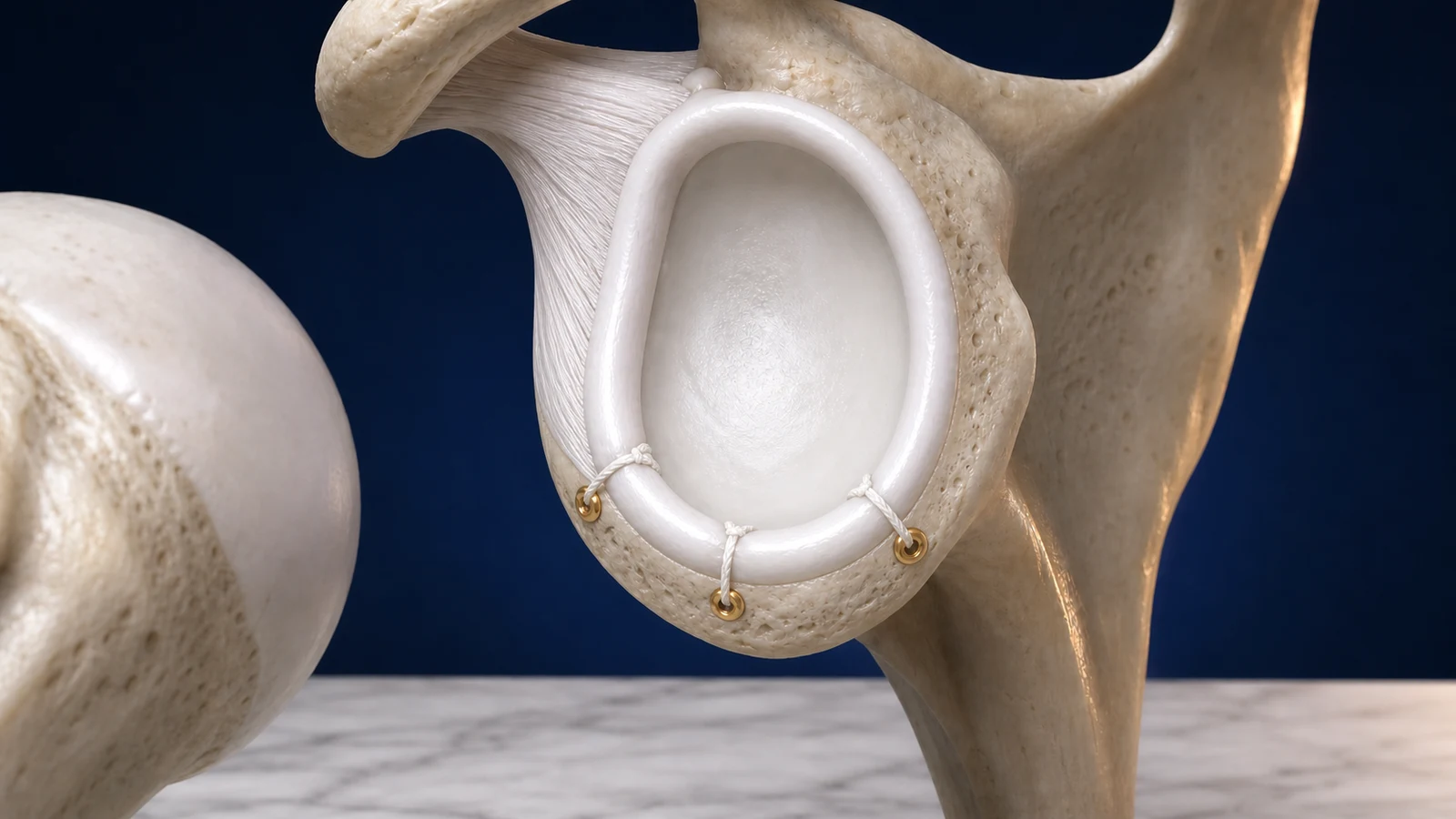
The operation usually takes about an hour, and what remains are a few millimetre-sized scars.
Remplissage — when the dent in the humeral head must also be filled
Sometimes the problem is not only at the front of the socket. If the dent at the back of the humeral head is large, then when the arm goes up and rotates outwards that hollow “engages” the front rim of the socket and — like a wheel dropping into a groove — throws the head out of the joint. In such a shoulder, repairing the labrum alone leaves that hollow untouched.
Remplissage — French for “filling” — is the answer to exactly this. In the same session and through the same camera, the surgeon uses anchors to stitch the posterior capsule and the infraspinatus tendon into the floor of that hollow, filling it. A defect that was inside the joint is effectively moved outside it and can no longer ride over the rim. It adds little time to the operation and, in suitable patients, clearly lowers the rate of re-dislocation. In exchange, the last few degrees of external rotation may stay limited — if you play a throwing sport, raise this with your surgeon before the operation.
B. Open Latarjet
When the bony rim of the socket has been worn away, stitching soft tissue onto a rim that is no longer there does not work. Instead of repairing, the Latarjet procedure adds bone.
It is done open, through an incision a few centimetres long at the front of the shoulder, along the natural interval between two muscles. The surgeon reaches the coracoid process: a small hook-shaped projection at the front of the shoulder blade with the conjoint tendon of two muscles attached to its tip. Part of this process — together with its tendon — is taken, passed through the fibres of the subscapularis muscle, placed on the front rim of the socket and fixed there with two screws. Finally the joint capsule is repaired as well.
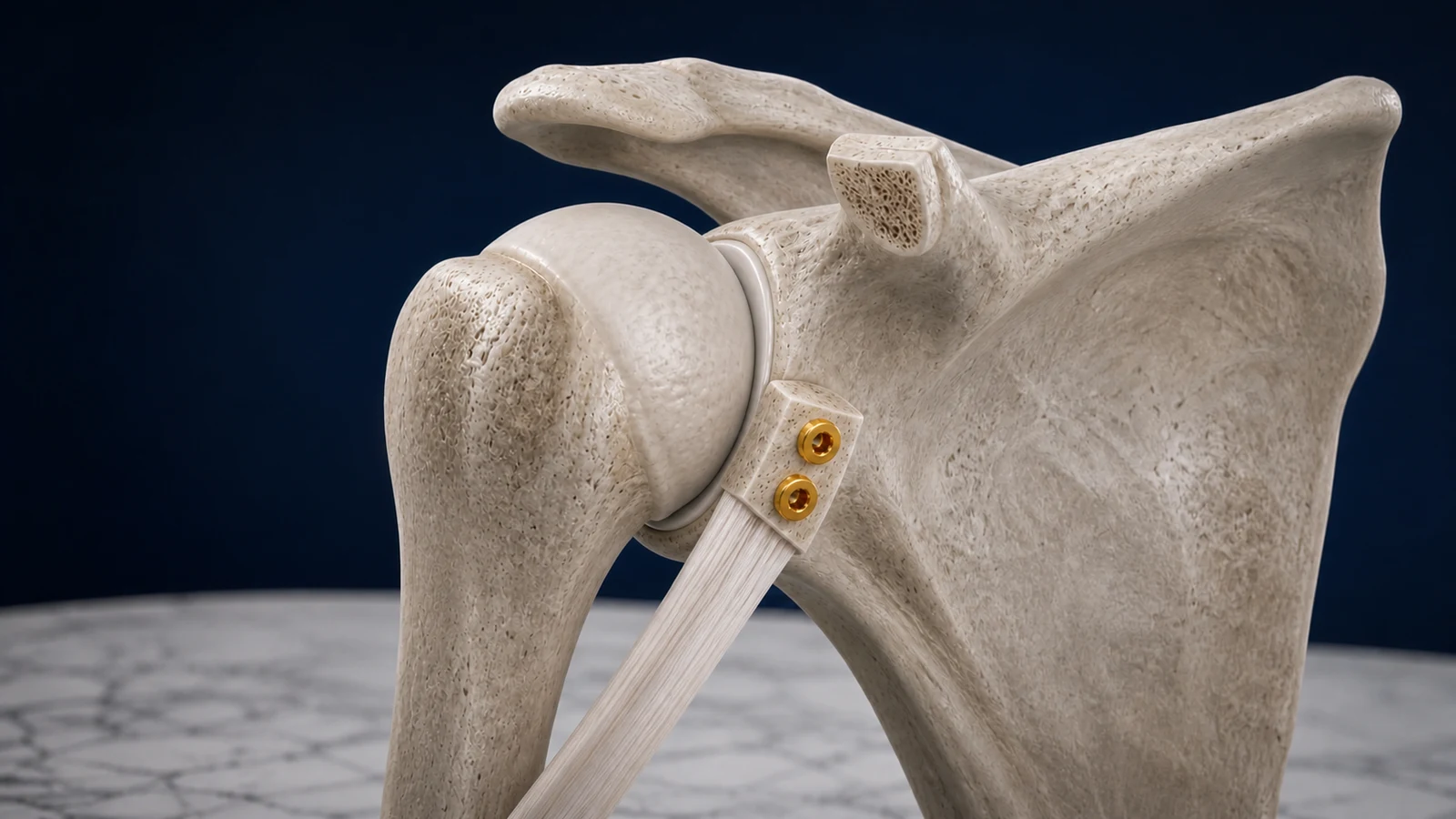
The reason this operation is so dependable is that it blocks dislocation in three ways at once. First, the bone graft rebuilds the missing arc at the front of the socket. Second — and, according to biomechanical studies, the most important part — the tendon transferred with the bone acts across the front of the joint like a living strap, tightening precisely in the danger position (arm up and rotated outwards) and holding the head back. Third, the capsular repair adds a third restraining layer.
The operation usually takes about one to one and a half hours. Latarjet can also be performed arthroscopically, but the standard approach in this practice is the open Latarjet with two screws. At the end of both operations the layers are closed and a dressing applied, the sling is fitted in the operating room itself, and you are taken to recovery.
🗓️ After surgery at a glance
Most patients go home the same day; sometimes, and particularly after open surgery, an overnight stay is needed. The numbness from the block lasts about a day: while the arm is numb, protect it from heat, pressure and knocks, and start your prescribed painkiller before the block wears off completely, not after.
The sling is the backbone of the first weeks. The usual range in reputable guidance is about three to six weeks, and the exact duration is set by the type of operation and your discharge sheet; during that time it comes off only for hygiene and for prescribed exercises. The wound is usually checked around day ten, and if the stitches are the removable type they come out then.
Physiotherapy starts in the first days, but protected: movement of the fingers, wrist and elbow is released early, while the shoulder moves only within the permitted range. The restricted direction in the early weeks is external rotation, because that is the movement which pulls on the fresh repair.
The broad lines of return: driving usually once the sling is off and around six to eight weeks; desk work earlier and heavy or overhead work several months later; and return to contact sport at around six months, on criteria rather than the calendar.
The full details of wound care, the step-by-step exercise programme, the warning signs and a safe return to activity are in a separate guide: the complete guide to care and rehabilitation after shoulder stabilisation surgery.
🎯 Returning to everyday life — answers to your 20 questions
These are the questions patients usually ask before deciding on surgery. The times are common ranges, not rules; your own team’s instructions take precedence.
1) How much pain will I have, and for how long?
While the nerve block is working you will feel almost no pain; the hardest hours are usually when it wears off, which is why you must start your prescribed painkiller before that happens. The first days are the most painful part of the road, after which the decline is noticeable. Discomfort with heavy activity or at the end of range can continue for some months.
2) How many nights will I stay in hospital?
Most patients having shoulder stabilisation go home the same day. After an open Latarjet an overnight stay is more likely. The discharge criterion is not the date: adequate alertness, controlled pain and nausea, being able to eat and drink, and having someone with you at home.
3) How long does the arm stay numb after the nerve block?
Usually about a day, sometimes a little longer. While the arm is numb you cannot feel pain or heat: do not lean on it, keep it away from radiators, hot water and hot water bottles, and watch that the fingers do not get trapped. If numbness or weakness lasts longer than expected, tell your treating team.
4) How long must I wear the sling?
The usual range in reputable guidance is about three to six weeks, and your exact figure depends on the operation and your surgeon’s written instruction. During that time the sling comes off only for hygiene, dressing and prescribed exercises. Do not abandon it early — that puts the repair at risk — and do not keep it on longer than instructed, which stiffens the shoulder.
5) How should I sleep at night?
Most patients are more comfortable semi-upright for the first weeks: with several pillows behind the head and trunk, or in a reclining chair. Put a pillow or rolled towel under the elbow so the arm does not fall backwards, because that backward drop pulls on the front of the joint. Sleeping on the operated shoulder is not done in the early weeks.
6) When can I shower?
This depends on your dressing and must be read from your discharge sheet; instructions differ between centres. Until the wound is fully closed, baths, swimming pools and public baths are not allowed. In the shower the sling comes off as instructed and the arm simply hangs; wash the armpit with the help of your good hand and without moving the arm away from the body.
7) When are the stitches removed?
The wound is usually checked around day ten after surgery, and if the stitches are the removable type they are taken out at that visit. If absorbable subcuticular sutures were used there is nothing to remove and the wound is simply checked. Until then, follow the dressing instructions on your discharge sheet.
8) What can I do with the elbow, wrist and fingers of that arm?
Gentle, unloaded movement of the fingers, wrist and elbow is released early in most programmes and is good for circulation and against stiffness. But that is different from “using the arm”: lifting objects, pushing yourself up out of a chair and leaning on the palm are not allowed in the early period. After a Latarjet, bending the elbow against resistance is also restricted, because the transferred tendon belongs to that same muscle.
9) When does physiotherapy start and how long does it last?
From the first days, but protected and within the range your programme allows. A regular programme usually runs for some months, and most of it consists of exercises you do yourself at home every day. Progress is measured by criteria — range of motion, strength and control — not by the number of sessions.
10) Why is external rotation restricted in the early weeks?
Because rotating the arm outwards pulls on exactly the tissue that has just been repaired or rebuilt: the labrum and capsule at the front of the joint, or the site where the bone graft is healing. Until the repair is solid, that pull can undo the work. The permitted ceiling for external rotation is written in your individual programme, and nobody — neither you nor whoever is helping you — should force the shoulder past it.
11) When can I drive?
Do not drive while you are wearing the sling. Return to driving usually becomes possible around six to eight weeks after surgery, but the conditions matter more than the date: sedating painkillers finished, and being able to hold the wheel with both hands without pain and perform an emergency manoeuvre. Try a short, quiet route first.
12) When can I go back to desk work?
Seated work is often possible earlier, and many patients return to office work in the sling within the first weeks, especially if the operated arm is not the dominant one. Arrange your desk so the mouse, keyboard and phone are within reach of the good hand and the operated arm does not have to reach.
13) What about heavy or overhead work?
In patient guidance, return to work is reported at roughly four to twelve weeks depending on the job, with manual trades at the far end of that range or later. Lifting heavy loads and sustained overhead work are usually set aside for about four to six months. Describe your actual job to your surgeon; “heavy work” means two completely different things for a bricklayer and for a hairdresser.
14) How should I pray?
Prayer during the sling period is not a problem and need not be postponed. The operated arm stays in the sling and the movements are made with the good hand; for prostration use a raised prayer stone or a chair so that no weight falls on the operated arm. The key point is not to place the palm of the operated side on the floor and push your body up with it when rising.
15) When is sexual activity possible?
Usually after a few weeks, once pain is controlled and the wound has closed, choosing positions that put neither weight nor stretch on the operated shoulder. While the shoulder restrictions are in force, the arm should not move away from the body and rotate outwards, and the palm of the operated side should not bear body weight. Raising this question with your treating team is entirely normal.
16) When can I travel or fly?
Short trips are often possible in the first weeks, provided you are not the driver and can keep the sling on throughout. For flying, especially a long flight, coordinate with your surgeon before buying the ticket, and use a wheeled case and a companion’s help; lifting a bag into the overhead locker is precisely the movement you must not make.
17) When are light activities such as walking, running or a stationary bike allowed?
Walking is allowed from the first days, in the sling, and is good for circulation and morale. Running and the stationary bike come into question once the sling is off and pain is controlled, because both carry mild impact or a risk of falling; agree the exact timing with your surgeon or physiotherapist. Lower-body training usually starts earlier, avoiding anything that involves the operated arm.
18) When can I return to competitive and contact sport?
For contact and throwing sports — wrestling, handball, volleyball, basketball, martial arts — the commonly reported time is around six months, but the date alone does not grant permission. The criteria are: sufficient range of motion, strength symmetrical with the healthy side, no fear or sense of instability in the danger position, and your surgeon’s approval. Returning too early is a well-recognised cause of failure.
19) Can the shoulder still dislocate after surgery?
Yes; no operation is at zero, and re-dislocation is a recognised complication of both procedures. In comparisons, the Latarjet generally has a lower rate of re-dislocation, while it carries a higher chance of further surgery for issues relating to the screws or the graft; patient satisfaction and function scores are close between the two. The most you can do yourself is to respect the restrictions of the early weeks and return to sport on criteria.
20) Do the Latarjet screws stay for life? Are they a problem for scans or airport gates?
The screws are usually left in place and not removed, unless they become troublesome, in which case they can be taken out once the bone graft has fully healed. They are not usually a problem at airport gates. Before an MRI scan, always tell the imaging centre that you have screws in your shoulder so that they can choose the appropriate settings.
✅ Summary and next step
A shoulder that dislocates repeatedly has a structural problem: the labrum has been stripped from the rim of the socket, and every repeat wears that rim further. Stabilisation is not an emergency, but time is not on its side. Which operation? If the bony rim is intact, arthroscopic labral repair — with remplissage where needed — finishes the job through a few small portals; if the rim has been worn away, the Latarjet restores the lost bone and, through its strap effect, restrains the shoulder precisely in the danger position. Both are well-established and effective, and choosing between them is a matter of examination and imaging, not guesswork.
To learn more about this area of treatment, see the shoulder surgery page.
To have your own shoulder assessed, contact the clinic of Dr Jalil Emad or book an appointment online.
09137825207 Book an appointment onlineRelated guides: Post-operative care and rehabilitation: Latarjet Shoulder Surgery: Postoperative Care and Rehabilitation · Service page: Shoulder & Elbow Surgery · Also related: Arthroscopic Rotator Cuff Tendon Repair Surgery: Postoperative Care and Rehabilitation
This content is intended purely for general education and is not a substitute for examination and the opinion of your own treating physician. The final decision about whether to operate and which operation to perform is made after examination, review of imaging and consideration of each patient’s individual circumstances. Change medicines and pre-operative preparations only in coordination with your surgical and anaesthesia teams.
📚 Scientific sources
View scientific sources
- AAOS OrthoInfo: Chronic Shoulder Instability and Dislocation — orthoinfo.org
- Carpinteiro EP, Barros AA. Natural History of Anterior Shoulder Instability. Open Orthop J 2017;11:909–918 — doi.org
- Galvin JW, et al. The Epidemiology and Natural History of Anterior Shoulder Instability. Curr Rev Musculoskelet Med 2017;10(4):411–424 — doi.org
- South Tees Hospitals NHS Foundation Trust: Shoulder stabilisation surgery — patient information — southtees.nhs.uk
- Frimley Health NHS Foundation Trust: Guidelines for patients having an arthroscopic stabilisation of their shoulder — fhft.nhs.uk
- Purchase RJ, Wolf EM, Hobgood ER, et al. Hill-Sachs “remplissage”: an arthroscopic solution for the engaging Hill-Sachs lesion. Arthroscopy 2008;24(6):723–726 — doi.org
- Yamamoto N, Muraki T, An KN, et al. The stabilizing mechanism of the Latarjet procedure: a cadaveric study. J Bone Joint Surg Am 2013;95(15):1390–1397 — doi.org
- van Spanning SH, et al. Similar patient-reported outcomes but lower redislocation and higher revision rates following primary Latarjet vs. primary arthroscopic Bankart repair. J Shoulder Elbow Surg 2025;34(9):2071–2078 — doi.org
- Mass General Brigham: Rehabilitation Protocol for Latarjet — massgeneral.org
- Aarhus University Hospital: Patient guide — shoulder stabilising surgery (Latarjet) — auh.dk
Dr. Jalil Emad
Orthopedic specialist and surgeon, board-certified in bone and joint surgery; years of experience in knee and hip replacement, sports injuries and arthroscopy in Isfahan.
Related articles
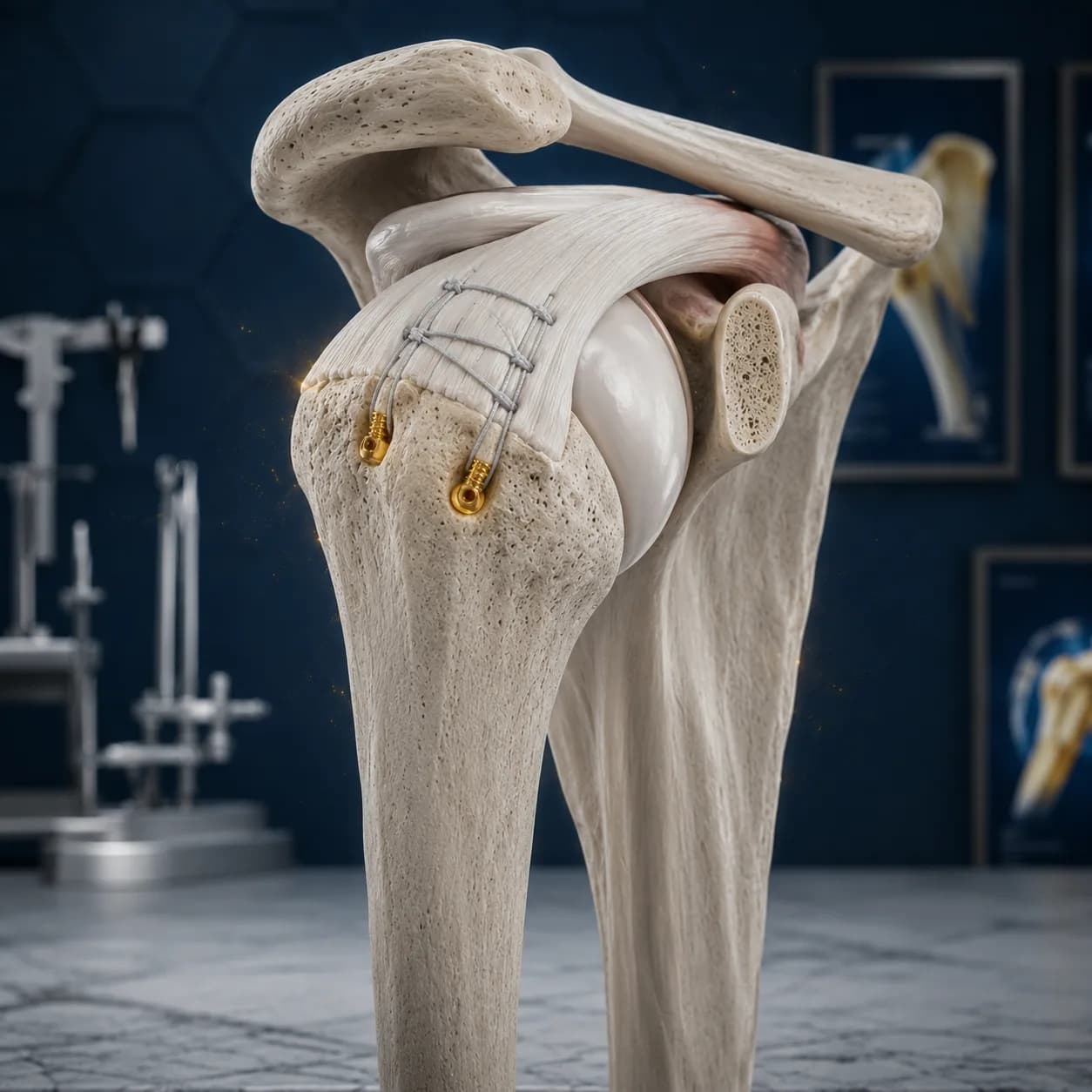
Arthroscopic Rotator Cuff Tendon Repair Surgery: Postoperative Care and Rehabilitation
A complete, criteria-based guide to care after arthroscopic rotator cuff repair—from dressing changes, sling use, and warning signs to the first 90 days of rehabilitation and a safer return to activity.
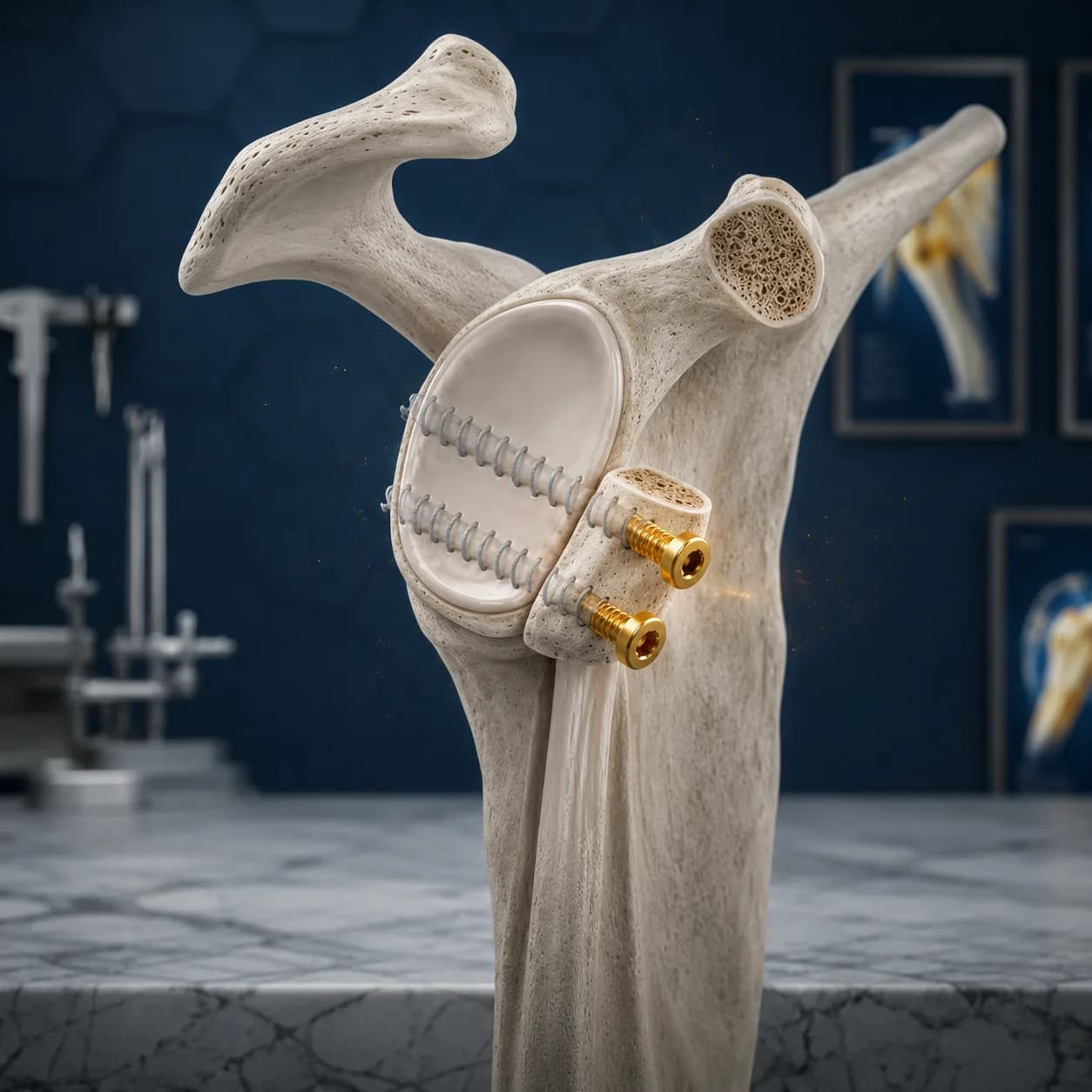
Latarjet Shoulder Surgery: Postoperative Care and Rehabilitation
A complete, criteria-based guide to surgery day and care after Latarjet shoulder surgery—from wound care, sling use, medicines, and warning signs to the first 90 days of rehabilitation and a safer return to activity.
Total Knee Replacement Surgery: Postoperative Care and Rehabilitation
Read knee replacement recovery step by step, from wound care and medicines to exercise. Progress depends on pain, swelling and movement.