On this page
🧭 Pick your situation
This guide comes in separate versions for different situations; read the one that matches yours.
Low Back Pain With Disc Involvement and Canal Narrowing Over 50: Daily Routines and Exercises
A practical guide to disc disease with canal narrowing over 50: interval walking, stationary cycling, flexion-biased stretches, a fall-safe home, gym principles, and red flags.
13 min read
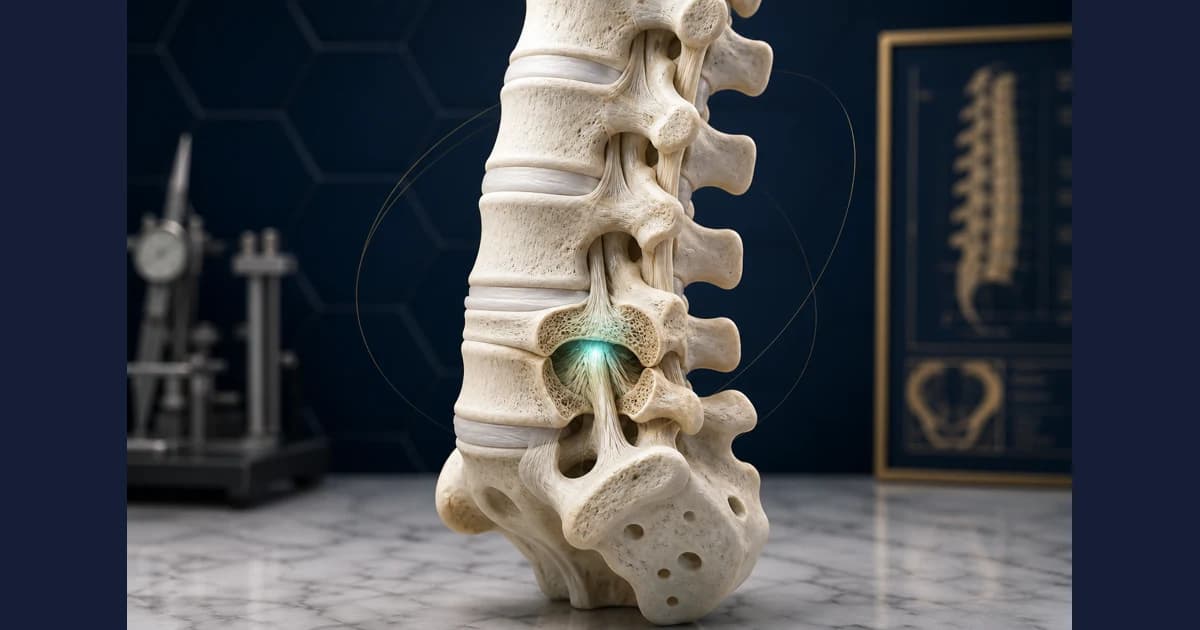
This version is for you if you are over 50 and a worn disc, together with narrowing of the spinal canal, makes your legs heavy and painful when you walk, while sitting or bending forward brings relief. The way forward is smart movement, not avoiding movement. This article is general education and is not a substitute for an examination; with severe symptoms or warning signs, get seen first.
1🦴 What is this condition, and what does your version mean?
As the years pass, the disc loses height, the joints and ligaments around the canal thicken, and the space the nerves pass through gets tighter. The most common result is "neurogenic claudication": after a while of walking or standing, the legs become heavy, painful, or tingly, and they calm down with sitting or bending forward — like leaning on a shopping cart — because bending opens the canal slightly. The clinical guideline for this condition makes multimodal non-surgical care the first line: education, lifestyle change, and a home exercise program. Reviews of the studies also show that the most effective programs include flexion-based exercises, trunk strengthening, and aerobic training — especially cycling. Surgery is considered for progressive symptoms or a serious limitation of quality of life, and that decision is made through an examination, not from a scan alone.
2🏠 Daily routines you should adjust
🚶 Walk in intervals — don't give walking up
Walk until just before your legs start to feel heavy, sit or bend forward until they settle, then continue; the sum of these segments is your daily exercise.
More detailLess detail
- Find your own threshold (say, ten minutes) and always plan a stop a little below it; over time this threshold gets longer.
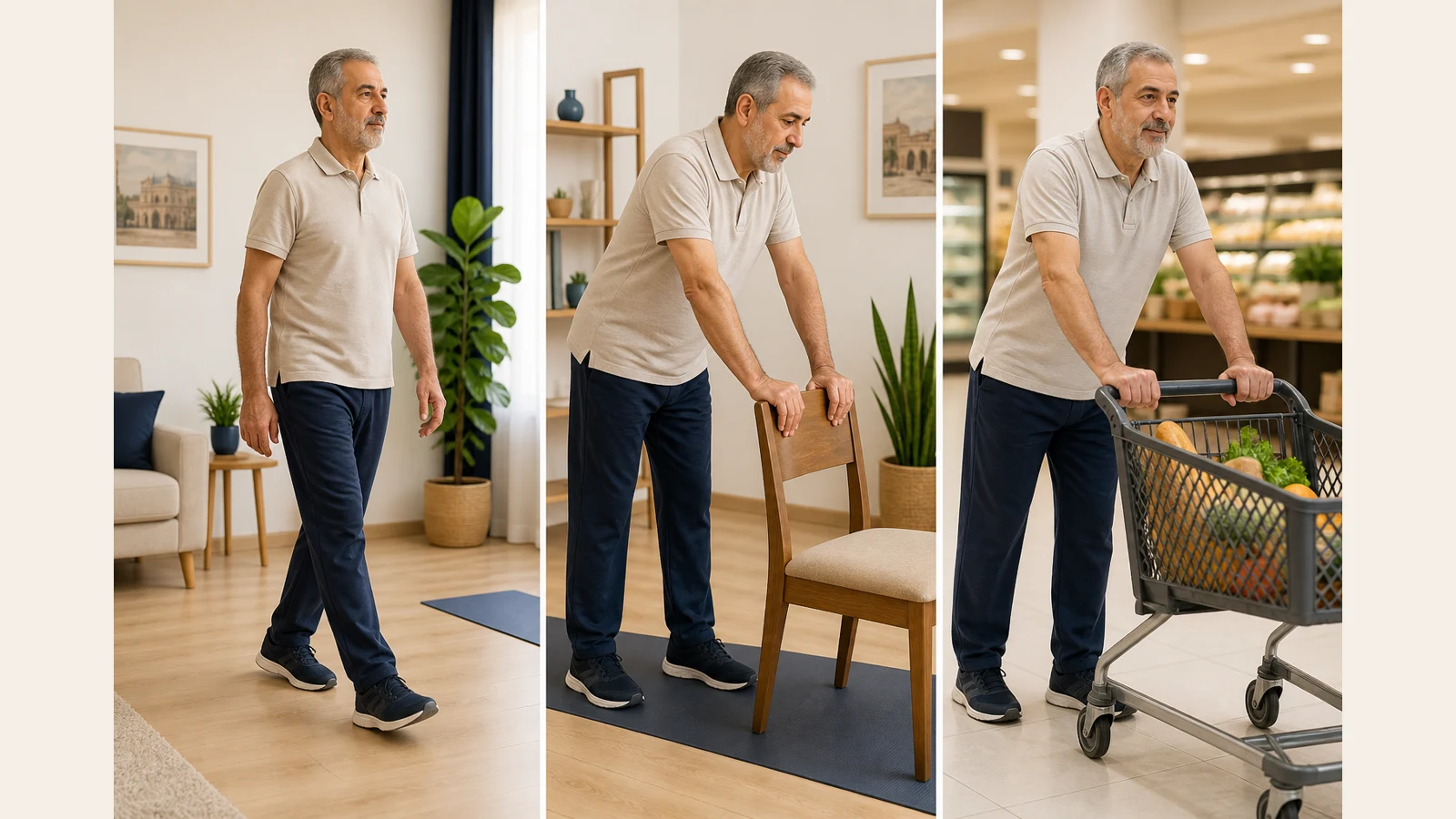
- Choose routes with places to sit; in shopping centers, the cart itself is your standard support.
🛒 Don't be embarrassed to use support
A shopping cart, a cane, or a walker are tools for keeping you moving, not a sign of defeat; whatever keeps you active is treatment.
More detailLess detail
- Leaning lightly forward while walking opens the canal a little and lengthens your symptom-free distance.
- Ask your care team about choosing the right cane or walker; the wrong height creates a new problem.
🪑 Plan sitting into standing tasks
Break up cooking, ironing, and queues with a stool and short sits; prolonged still standing is the enemy of a narrow canal.
More detailLess detail
- Keep a tall stool in the kitchen and do longer tasks sitting down.
- When you must stand, rest one foot on a step or low stool so your back stays slightly flexed.
🏡 Fall-proof your home
A tingling, numb foot senses the ground less well; in this version, fall prevention is more serious than ever.
More detailLess detail
- Secure rug edges, tidy away cables, and keep the route from bedroom to bathroom lit at night.
- Wear closed-toe slippers with a grippy sole and put a non-slip mat in the bathroom.
🦴 Keep track of your bone health
At this age, bone density is part of the back equation; osteoporosis is silent, and a vertebral fracture makes the narrowing more complicated.
More detailLess detail
- Talk to your doctor about bone density testing and calcium and vitamin D; no self-prescribed supplements.
- According to the international recommendations, a bone exercise program must be "resistance + balance"; the exercise section here follows exactly that.
⚖️ Manage weight and sleep
Every extra kilogram adds load to a narrow canal; good sleep also raises your pain threshold.
More detailLess detail
- Sleep on your side with knees drawn up (a gentle fetal position) or on your back with a pillow under the knees; these positions keep the canal more open.
- Gradual weight loss through small, sustainable changes works better than harsh diets.
3🏋️ Home exercises
The rule for this version is simple: flexion-based positions are your friends, and prolonged extension is the enemy. Do the exercises within your symptom-free range; the doses are common ranges from exercise therapy, and your care team can adjust them.
Interval Walking (Interval Walking)
Walk until just before your symptom threshold, rest sitting, then continue; slowly build up the daily total. Stop with leg weakness or chest pain.
More detailLess detail
Goal and why: keeping your heart and legs fit without waking the neurogenic claudication; staying active predicts a better future for you.
Starting position: comfortable shoes, a flat route with places to sit; a cane or shopping cart if needed.
Step-by-step execution:
- Set your walking bouts a little shorter than your own symptom threshold.
- Between bouts, sit or lean forward for 1 to 3 minutes until your legs settle completely.
- Add a little to the daily total each week; the goal is a total of about 30 minutes a day.
Documented dose: a total of about 30 minutes a day in several bouts, most days of the week.
Stop immediately if: clear leg weakness, chest pain, shortness of breath, or dizziness.
Common mistakes: pushing on until the legs give out completely; giving up walking out of fear of symptoms.
Easier version: walking behind a shopping cart or walker, leaning lightly forward.
Stationary Cycling (Stationary Cycling)
The favorite aerobic exercise for this condition: on the bike the body is slightly flexed and the legs work without symptoms. 10 to 20 minutes at light resistance, most days of the week. Stop with knee pain or dizziness.
More detailLess detail
Goal and why: in reviews of canal-narrowing studies, cycling is one of the most frequent components of successful programs; the heart and legs get stronger without putting the canal under pressure.
Starting position: set the saddle so the knee stays slightly bent at the lowest point and the trunk is comfortable and slightly forward.
Step-by-step execution:
- Warm up for 2 to 3 minutes at zero resistance.
- Pedal at light resistance; breathing quicker but conversation still possible.
- At the end, pedal gently for 2 minutes, then get off.
Documented dose: 10 to 20 minutes, most days of the week; increase gradually.
Stop immediately if: knee pain, dizziness, or worsening leg symptoms.
Common mistakes: a saddle set too low (knee strain); heavy resistance from the first session.
Easier version: a recumbent bike with a backrest (Recumbent) at the gym.
Knee-to-Chest (Knee-to-Chest)
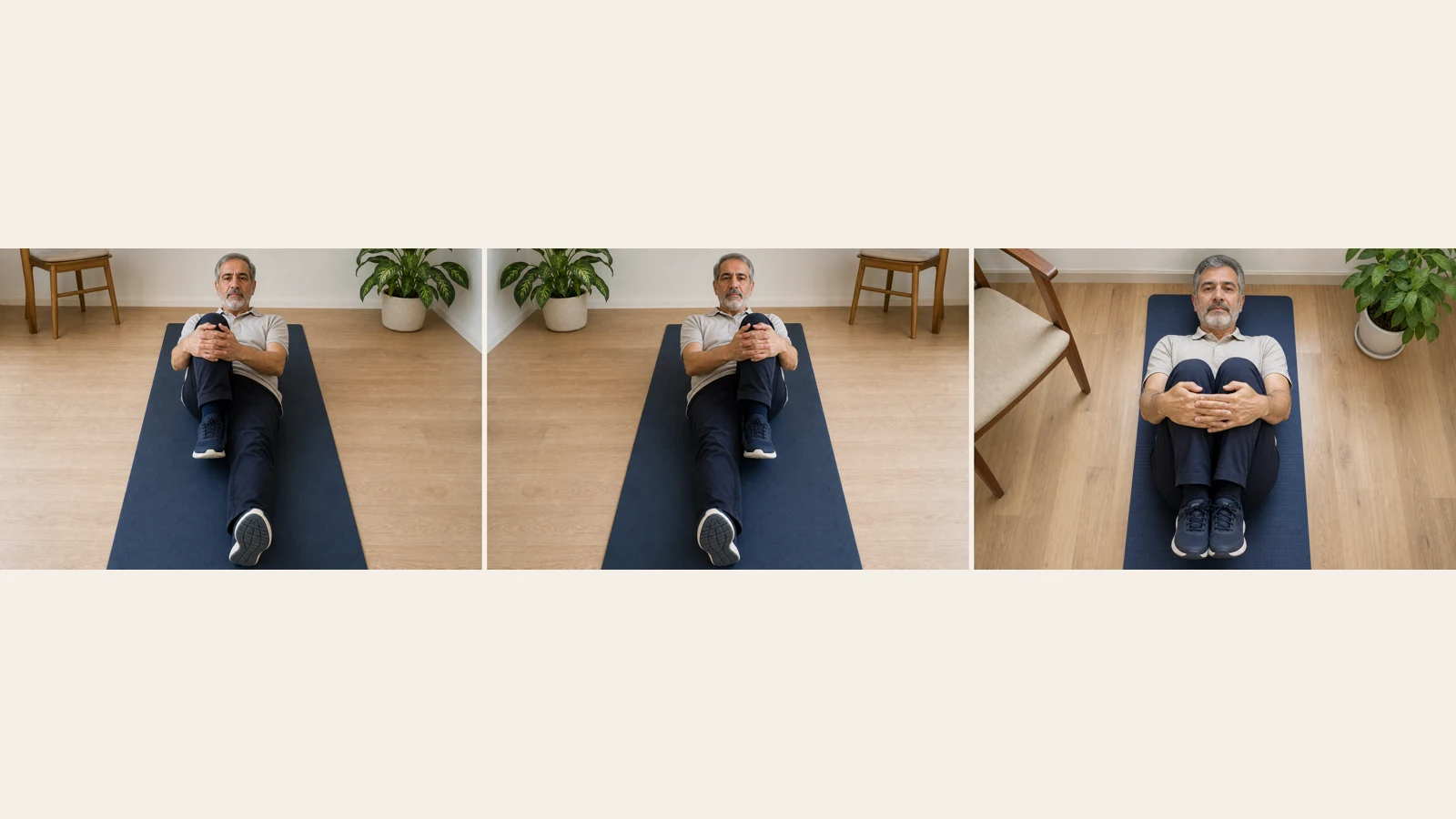
The classic flexion stretch for this condition: the knees come toward the chest and the canal gets a few moments to "breathe". 5 to 8 repetitions with a 10-to-20-second hold, 2 sets a day. Stop with hip pain.
More detailLess detail
Goal and why: flexing the hips and low back temporarily opens the canal space and calms the leg symptoms — the same thing sitting does, this time as an exercise.
Starting position: lying on your back on a fairly firm surface, knees bent, feet flat on the floor.
Step-by-step execution:
- First bring one knee toward your chest with both hands and hold for 10 to 20 seconds.
- Switch legs.
- If that feels comfortable, hug both knees together and hold.
Documented dose: 5 to 8 repetitions, holding 10 to 20 seconds, 2 sets a day.
Stop immediately if: sharp hip or groin pain, or worsening leg tingling.
Common mistakes: pulling with jerks and sudden force; lifting the head and neck off the floor.
Easier version: holding the back of the thigh instead of the shin; or one knee only.
Posterior Pelvic Tilt (Posterior Pelvic Tilt)
A small movement that takes the extra arch out of the low back — exactly the direction your canal likes. 8 to 10 repetitions with a 5-second pause, 2 sets a day. Stop with sharp pain.
More detailLess detail
Goal and why: pelvic control is the foundation of low-symptom standing and walking; arching the back narrows the canal, and this exercise teaches the opposite.
Starting position: on your back, knees bent, feet flat on the floor.
Step-by-step execution:
- As you exhale, draw your belly in and press the arch of your back flat against the floor.
- Hold for 5 seconds; don't hold your breath.
- Release slowly and repeat.
Documented dose: 8 to 10 repetitions, 2 sets a day.
Stop immediately if: sharp back pain or symptoms radiating down the leg.
Common mistakes: pushing with the legs instead of the belly; lifting the pelvis off the floor.
Easier version: the same movement sitting on a chair.
Seated Forward Stretch (Seated Forward Stretch)
A gentle forward bend from a chair to open the canal and calm the legs. 5 repetitions with a 10-second hold, whenever the legs feel heavy. Stop with dizziness.
More detailLess detail
Goal and why: the exercise version of "leaning on the shopping cart"; your instant tool for the middle of the day.
Starting position: sitting on a sturdy chair, feet shoulder-width apart.
Step-by-step execution:
- As you exhale, bend gently forward from the hips and let your hands hang toward the floor.
- Stay in a comfortable position for 10 seconds.
- Come back up slowly, pushing with your hands on your thighs.
Documented dose: 5 repetitions with a 10-second hold; throughout the day whenever symptoms build up.
Stop immediately if: dizziness or light-headedness when coming up.
Common mistakes: getting up quickly; bending with a stiff back instead of letting go.
Easier version: bending less, only until the elbows rest on the thighs.
Supported Balance (Supported Balance)
A tingling foot reduces your balance; balance practice next to a support is your anti-fall insurance. 3 holds of 10 to 20 seconds per leg, daily. Stop with dizziness.
More detailLess detail
Goal and why: according to the bone-health recommendations, balance is the inseparable half of the program at this age; with a foot that feels less, it matters twice as much.
Starting position: next to a table or the back of a chair, one hand close to the support.
Step-by-step execution:
- Shift your weight onto one leg and lift the other slightly off the floor.
- Stand tall for 10 to 20 seconds.
- Switch legs; as you improve, lighten your grip on the support.
Documented dose: 3 holds of 10 to 20 seconds for each leg, preferably daily.
Stop immediately if: dizziness or severe unsteadiness.
Common mistakes: practicing far from a support; looking down.
Easier version: feet in one line (heel in front of toes) with both hands on the support.
4🏟️ Gym training principles
The gym has one rule for this version: seated and flexion-based, yes; prolonged standing and extension-loaded, no.
- Main aerobic work: a stationary or recumbent bike (Recumbent); treadmill only briefly, at zero incline, leaning lightly on the handrails.
- Strengthen on seated machines (leg press, chest press, lat pulldown) with light-to-moderate load and 8 to 12 well-formed repetitions.
- The program must include resistance and balance work, not just aerobics; 2 to 3 sessions a week is enough.
- Between exercises, sit on a bench instead of standing, so leg symptoms don't build up.
- If you have osteoporosis, coordinate the program with your doctor.
5⚠️ Warning signs — see a doctor immediately
These signs mean close this article and act immediately:
- Loss of control or retention of urine or stool, or numbness in the genital area and around the anus
- Progressive leg weakness, a dropping foot, or repeated falls
- Sudden severe back pain after a fall or minor strain — a possible vertebral fracture
- Pain at night or at rest that does not ease with a change of position
- Fever, unexplained weight loss, or a history of cancer
- Calf pain that eases with simply standing still (without bending forward) or comes with a cold, pale foot — this must be distinguished from a vascular problem; be sure to tell your doctor
6✅ Summary and next step
Canal narrowing means you should move smart, not less: interval walking, cycling, flexion-based stretches, and leg and trunk strengthening, plus a safe home and healthy bones. If your symptom-free distance is getting shorter month by month, or you notice a warning sign, it is time for an examination; we will go over the next options together right there.
If neurogenic claudication is limiting your daily life, book an appointment for a personalized assessment and a review of all your options.
To learn more, see the spine care page and the bone health page.
This content is provided for general education only and is not a substitute for an examination and your own doctor's advice. If you have warning signs or your symptoms are getting worse, get examined before continuing the exercises. Adjust the intensity and type of exercise to your own condition and your care team's advice.
View scientific sources
- Bussières A, et al. Non-Surgical Interventions for Lumbar Spinal Stenosis Leading To Neurogenic Claudication: A Clinical Practice Guideline. J Pain. 2021. doi.org/10.1016/j.jpain.2021.03.147
- Comer C, et al. Exercise treatments for lumbar spinal stenosis: A systematic review and intervention component analysis of randomised controlled trials. Clin Rehabil. 2024. doi.org/10.1177/02692155231201048
- Apeldoorn AT, et al. Management of low back pain and lumbosacral radicular syndrome: the KNGF Guideline. Eur J Phys Rehabil Med. 2024. doi.org/10.23736/S1973-9087.24.08352-7
- Hutchins TA, et al. ACR Appropriateness Criteria: Low Back Pain, 2021 Update. J Am Coll Radiol. 2021. doi.org/10.1016/j.jacr.2021.08.002
- Hayden JA, et al. Exercise therapy for chronic low back pain. Cochrane Database Syst Rev. 2021. doi.org/10.1002/14651858.CD009790.pub2
- Giangregorio LM, et al. Too Fit To Fracture: exercise recommendations for individuals with osteoporosis or osteoporotic vertebral fracture. Osteoporos Int. 2014. doi.org/10.1007/s00198-013-2523-2

Dr. Jalil Emad
Orthopedic specialist and surgeon, board-certified in bone and joint surgery; years of experience in knee and hip replacement, sports injuries and arthroscopy in Isfahan.
Related articles

Total Knee Replacement: The Pre-Operative Guide
What to know before knee replacement: what knee osteoarthritis is, what happens if you do not operate, how to prepare, what takes place in the operating room, and answers to 20 questions about returning to daily life.
Carpal Tunnel Release Surgery: Wound Care and Finger Movement
A short, evidence-based guide to the first days after carpal tunnel release—from the dressing, showering and warning signs to finger movement, returning to work and common questions.
Latarjet Shoulder Surgery: Postoperative Care and Rehabilitation
A complete, criteria-based guide to surgery day and care after Latarjet shoulder surgery—from wound care, sling use, medicines, and warning signs to the first 90 days of rehabilitation and a safer return to activity.