
On this page
🧭 Pick your situation
This guide comes in separate versions for different situations; read the one that matches yours.
Low Back Pain With Disc Involvement Under 50: Daily Routines and Exercises
A practical guide to lumbar disc herniation and sciatica under 50: the centralization rule, neutral-spine lifting, McKenzie-style directional exercises, and a staged return to the gym.
13 min read
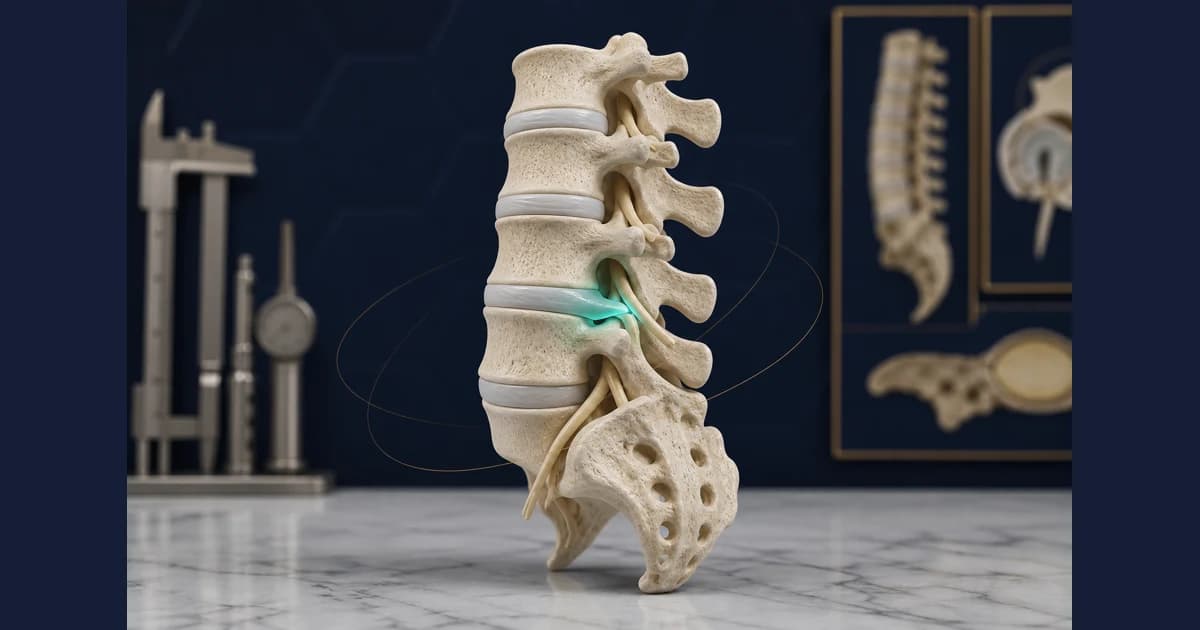
This version is for you if you are under 50 and a lumbar disc is pressing on a nerve root: pain that shoots into the buttock and down the leg, sometimes with tingling or numbness. The important news is that most disc problems settle without surgery within a few weeks to a few months — if you move the right way. This article is general education and does not replace an examination; with severe symptoms or any warning signs, get seen first.
1🦴 What is this condition, and what does your version mean?
The disc is the gel-like cushion between the vertebrae; when part of it bulges out and presses on a nerve root, back pain shoots along that nerve's path into the buttock and leg (sciatica) and may bring tingling or numbness with it. Clinical guidelines treat this condition on a separate pathway from simple back pain, but its natural course is usually good: most patients improve substantially with non-surgical treatment within six to twelve weeks, and the herniated fragment often shrinks over time. An urgent MRI is only needed when warning signs are present. Surgery is considered for a small group who have progressive weakness or whose pain persists despite a full course of non-surgical treatment — that decision is made through an examination, not from a scan alone.
2🏠 Daily routines you need to adjust
🚶 Stay active; no strict bed rest
Lying down for more than a day or two weakens the muscles and prolongs the pain; walk as tolerated and keep doing light tasks.
More detailLess detail
- The golden rule: an activity is good if it draws the leg pain "back toward the spine"; an activity that pushes the pain further down the leg is too much for now.
- On bad days, cut the distance and duration — but never to zero.
🪑 Keep sitting short and supported
Prolonged sitting raises the pressure inside the disc and wakes the leg pain; stand up every 20 to 30 minutes.
More detailLess detail
- Fill the hollow of your lower back with a small cushion and slide your hips all the way back in the chair; a soft, sagging seat is not suitable for now.
- On long drives, plan regular stops and walk a few steps.
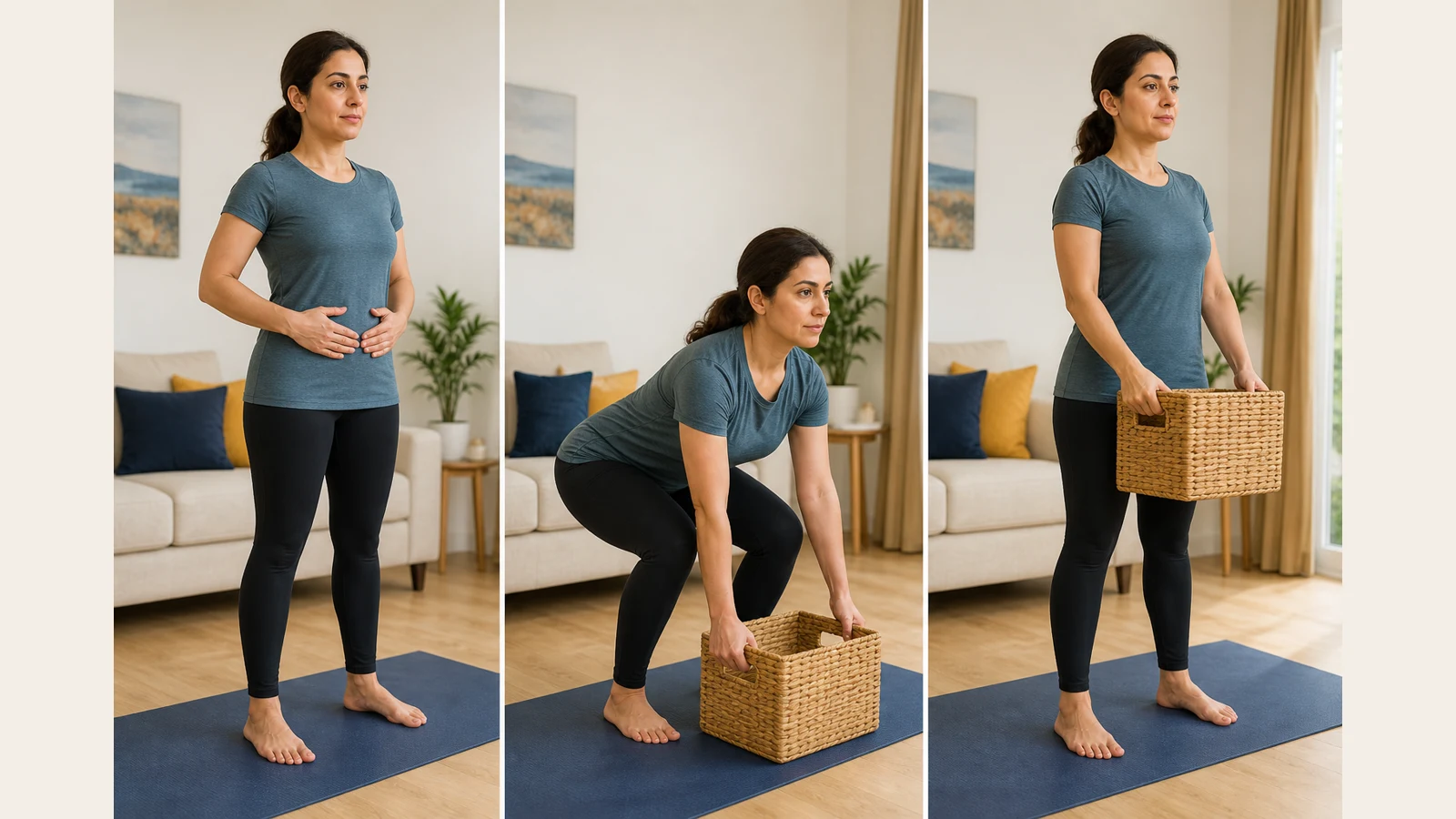
📦 Lift only with a neutral spine
In this version, fully bending the back under load is the single most important movement to eliminate: knees bent, the object held close to your body, back straight.
More detailLess detail
- Before every lift, gently brace your abdomen as if fastening an invisible belt, and keep the object between your feet.
- Hand heavy loads to others while you have symptoms; this restriction is temporary, not permanent.
🔄 Eliminate bending and twisting at the same time
Combining a forward bend with a twist — like pulling a suitcase out of a car trunk — is the worst possible pattern for a symptomatic disc.
More detailLess detail
- First turn to face the object fully, then lift it with bent knees; to turn, move your feet, not your back.
- Delegate repetitive tasks with this pattern until your symptoms settle.
🤧 Manage sneezing and coughing
A sneeze spikes the pressure inside the disc suddenly; sneeze with your abdomen braced and your trunk leaning slightly back, not bent forward.
More detailLess detail
- When you sneeze, rest a hand against the wall and bend your knees slightly.
- Take constipation seriously; straining creates the same pressure.
🛏 Set up your sleep to protect the nerve
Sleep on your side with a pillow between your knees; if lying face down eases the leg pain, short spells on your stomach are helpful too.
More detailLess detail
- To get up, roll onto your side first and push up with your arm; never sit straight up out of bed.
- If leg pain wakes you at night and is getting worse, be sure to mention it at your visit.
3🏋️ Home exercises
The compass for every exercise is the "centralization rule": if the leg pain moves up and draws back toward the spine, you are on the right track; if it moves further down, stop that exercise. The direction-based exercises come from the McKenzie approach, which has shown meaningful improvement in a systematic review. The doses are common ranges used in exercise therapy, and your care team may adjust them.
Short Frequent Walks (Short Frequent Walks)
3 to 5 bouts of 5 to 10 minutes a day; as symptoms improve, make the bouts longer and fewer. If the pain moves down the leg, stop.
More detailLess detail
Goal and rationale: Walking keeps the nerve gliding without loading the disc the way sitting does.
Starting position: Comfortable shoes, tall posture, normal strides.
Step-by-step execution:
- Start the day with 5-minute bouts.
- If the leg stays calm, add 2 to 3 minutes to each bout every few days.
- As symptoms settle, work up to a single 30-minute daily walk.
Documented dose: Start with 3 to 5 × 5 to 10 minutes a day; final goal about 30 minutes, 5 days a week.
Stop immediately if: Pain or tingling spreads below the knee, or the leg feels weak.
Common mistakes: One long walk instead of several short bouts; pushing on while the pain travels downward.
Easier version: Walk around the house for 2 to 3 minutes every waking hour.
Prone Lying (Prone Lying)
The first step of the direction-based approach: 5 to 10 minutes lying quietly on your stomach, 2 to 3 times a day. If the leg pain increases or moves further down, stop.
More detailLess detail
Goal and rationale: Lying prone is the first rung of extension and lets many discs allow the pain to "draw back in".
Starting position: On your stomach, head turned to one side, arms by your sides; a thin pillow under the abdomen if needed.
Step-by-step execution:
- Lie down on your stomach slowly and let your whole body relax completely.
- Take a few deep breaths and let your back settle.
- Stay for 5 to 10 minutes; pay attention to where the leg pain moves.
Documented dose: 5 to 10 minutes, 2 to 3 times a day.
Stop immediately if: The leg pain or tingling moves further down or gets stronger.
Common mistakes: Tolerating pain that is travelling downward "hoping it will get better".
Easier version: Use a thicker pillow under the abdomen and shorten the time.
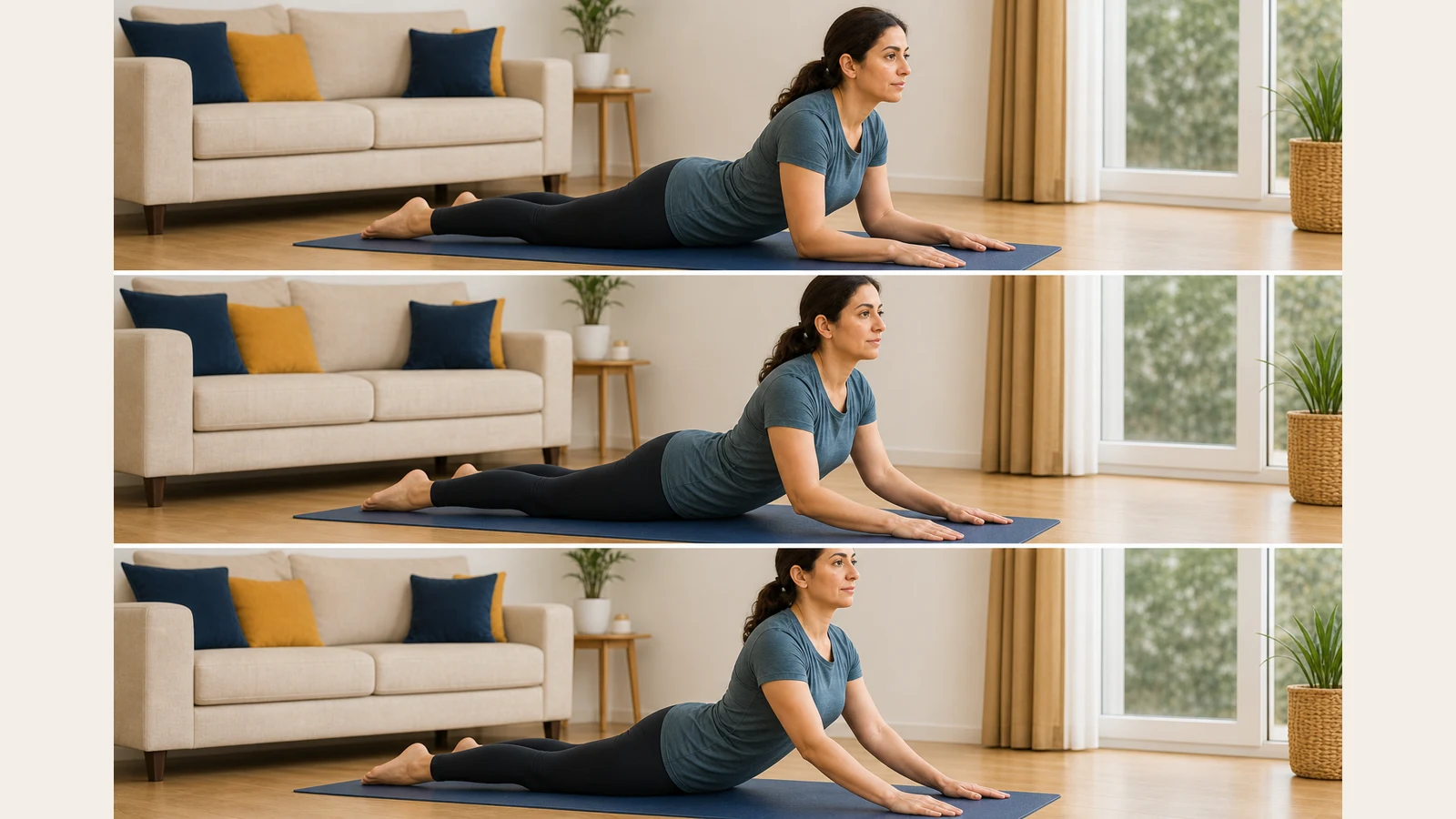
Prone Press-Up (Prone Press-Up)
The key direction-based exercise: from the prone position, push through your hands to raise the upper body while the pelvis stays on the floor. 8 to 10 repetitions, 2 to 3 times a day — only through the range that draws the leg pain upward. If the pain spreads downward, stop.
More detailLess detail
Goal and rationale: In patients with a directional preference, repeated extension "centralizes" the pain from the leg back to the spine — a sign the nerve root is settling.
Starting position: Prone, palms under the shoulders, pelvis and legs relaxed.
Step-by-step execution:
- First do a few repetitions propped on your elbows (half-raised).
- Then straighten your elbows gradually to lift the upper body; keep the pelvis on the floor and the lower back relaxed.
- Pause for one breath at the top, then lower slowly.
- Take each repetition slightly higher, but only if the leg pain is drawing back in.
Documented dose: 8 to 10 repetitions, 2 to 3 times a day (the common McKenzie-approach pattern).
Stop immediately if: Pain or tingling moves below the knee, or the back locks up.
Common mistakes: Lifting the pelvis off the floor; tensing the buttocks and back instead of staying relaxed; rushing the range.
Easier version: Stay with the elbow-prop stage (Prone on Elbows) for a few days.
Sciatic Nerve Glide (Sciatic Nerve Glide)
A gentle knee-and-ankle movement that "flosses" the nerve softly. 8 to 10 repetitions on the painful leg, 2 times a day. Stop if the tingling becomes intense.
More detailLess detail
Goal and rationale: An irritated nerve responds better to gentle movement than to prolonged stretching.
Starting position: On your back, holding the thigh of the painful leg with both hands behind the knee, knee bent.
Step-by-step execution:
- Slowly straighten the knee as far as is comfortable; a mild stretch behind the thigh is normal.
- At the same time, pull the ankle toward you, then relax it.
- Bend the knee again and repeat the movement at a calm rhythm.
Documented dose: 8 to 10 repetitions, 2 times a day.
Stop immediately if: Intense tingling or electric-shock sensations, or pain that persists after the exercise.
Common mistakes: Straightening the knee fully and holding it for a long time; performing the movement too fast.
Easier version: Move only the ankle, with the knee bent further.
Pain-Free Cat–Camel (Pain-Free Cat–Camel)
Gentle spinal movement, only within the range that does not wake the leg pain; in this version, keep the "rounding" range small. 6 to 8 slow repetitions. Stop if the pain spreads.
More detailLess detail
Goal and rationale: Keeps the back from stiffening during the symptomatic period, without challenging the disc.
Starting position: On hands and knees; hands under the shoulders, knees under the hips.
Step-by-step execution:
- As you breathe in, arch the lower back slightly (this direction is usually your friend).
- As you breathe out, return only to a flat back; full rounding is not needed.
- Repeat at a slow rhythm and listen to how the leg responds.
Documented dose: 6 to 8 repetitions, 1 to 2 times a day.
Stop immediately if: Pain or tingling spreads into the leg.
Common mistakes: Rounding the back deeply; moving too fast.
Easier version: Do only the arching direction and stop the return at a flat line.
Glute Bridge (Glute Bridge)
Strengthens the buttocks with a neutral spine; in this version keep the range shorter than usual. 6 to 10 repetitions, 2 sets. If the pain shoots into the leg, stop.
More detailLess detail
Goal and rationale: Strong glutes make the safe lifting pattern possible and reduce the load on the disc.
Starting position: On your back, knees bent, feet flat on the floor, abdomen slightly braced.
Step-by-step execution:
- Press through your heels to lift the pelvis to a comfortable line; do not add extra arch to the lower back.
- Pause for 2 seconds.
- Lower slowly, vertebra by vertebra.
Documented dose: 6 to 10 repetitions, 2 sets.
Stop immediately if: Pain spreads into the leg or a sharp pain hits the back.
Common mistakes: Going for maximum range; holding your breath.
Easier version: Just squeeze the buttocks without lifting the pelvis.
4🏟️ Gym training principles
In this version the gym does not close, but it goes into "safe mode" until the leg symptoms settle:
- For now, use seated machines with back support and light loads; seated upper-body work is usually trouble-free.
- After a few symptom-free weeks, relearn the squat and deadlift with an empty bar under a coach's supervision, and bring the load back step by step.
- The centralization rule applies in the gym too: any movement that sends pain into the leg is dropped on the spot.
- Before every session, do 5 to 10 minutes of light aerobic warm-up and a few prone press-ups.
5⚠️ Warning signs — see a doctor immediately
With a lumbar disc, these symptoms are emergencies; close this article and act immediately:
- Loss of control or retention of urine or stool, or numbness in the genital area and around the anus (every hour counts)
- Progressive leg weakness, a foot that drops while walking, or a knee that repeatedly gives way
- Pain or numbness in both legs at the same time
- Constant night pain that does not ease with a change of position
- Fever, unexplained weight loss, or a history of cancer
- Pain that keeps getting worse after several weeks despite proper treatment
6✅ Summary and next step
A symptomatic disc at your age usually improves with the right movement: stay active, keep sitting spells short, lift with a neutral spine, and continue the direction-based exercises with centralization as your compass. If symptoms do not improve, or you notice any warning sign, an examination is essential.
If the leg pain persists, or you want to know whether you are on the right track, book a visit for a personalized assessment.
To learn more about this area of care, see the spine care page.
This content is provided for general education only and does not replace an examination and your doctor's advice. If you have warning signs, or the pain does not improve within a few weeks despite these adjustments, get examined before continuing the exercises. Adjust the intensity and type of exercise to your own condition and your care team's advice.
View scientific sources
- Apeldoorn AT, et al. Management of low back pain and lumbosacral radicular syndrome: the KNGF Guideline. Eur J Phys Rehabil Med. 2024. doi.org/10.23736/S1973-9087.24.08352-7
- Bailly F, et al. Clinical guidelines and care pathway for management of low back pain with or without radicular pain. Joint Bone Spine. 2021. doi.org/10.1016/j.jbspin.2021.105227
- Hennemann V, et al. The McKenzie Method delivered by credentialed therapists for chronic low back pain with directional preference: systematic review with meta-analysis. J Man Manip Ther. 2025. doi.org/10.1080/10669817.2024.2408084
- Hutchins TA, et al. ACR Appropriateness Criteria: Low Back Pain, 2021 Update. J Am Coll Radiol. 2021. doi.org/10.1016/j.jacr.2021.08.002
- Hayden JA, et al. Exercise therapy for chronic low back pain. Cochrane Database Syst Rev. 2021. doi.org/10.1002/14651858.CD009790.pub2
- Pocovi NC, et al. An individualised, progressive walking and education intervention for the prevention of low back pain recurrence (WalkBack): a randomised controlled trial. Lancet. 2024. doi.org/10.1016/S0140-6736(24)00755-4

Dr. Jalil Emad
Orthopedic specialist and surgeon, board-certified in bone and joint surgery; years of experience in knee and hip replacement, sports injuries and arthroscopy in Isfahan.
Related articles

Total Knee Replacement: The Pre-Operative Guide
What to know before knee replacement: what knee osteoarthritis is, what happens if you do not operate, how to prepare, what takes place in the operating room, and answers to 20 questions about returning to daily life.
Carpal Tunnel Release Surgery: Wound Care and Finger Movement
A short, evidence-based guide to the first days after carpal tunnel release—from the dressing, showering and warning signs to finger movement, returning to work and common questions.
Latarjet Shoulder Surgery: Postoperative Care and Rehabilitation
A complete, criteria-based guide to surgery day and care after Latarjet shoulder surgery—from wound care, sling use, medicines, and warning signs to the first 90 days of rehabilitation and a safer return to activity.